
When Ad Tech Sprinkles Fairy Dust…
by Shirley Marschall on 8th Apr 2026 in News
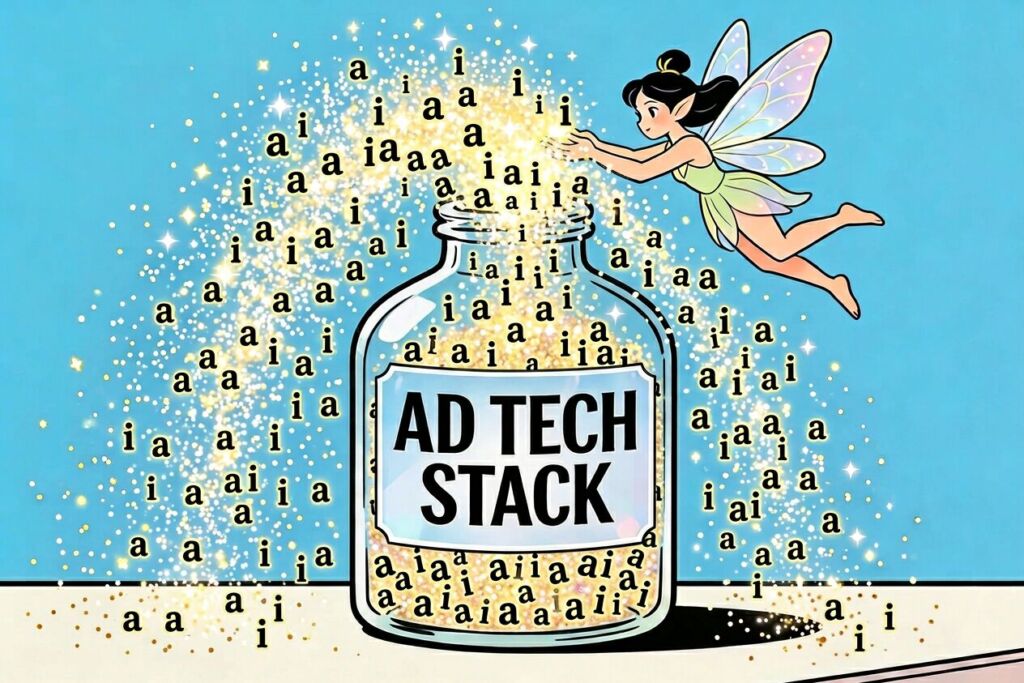
Shirley is back, and this week's column looks at why sometimes special ingredients are there to drive the narrative, not the performance...
Some things sound better on the label than they perform in reality.
Skincare products "with Vitamin C". Snacks "infused" with protein. Shampoo "with keratin". The ingredient is technically there, just not in a way that meaningfully changes anything. There's a name for this in the cosmetics industry: fairy dusting. You add a small drop of something science-y to the formula and let it carry most of the marketing story.
Ad tech has its own version. It just calls it something else. Usually… innovation.
Ad tech fairies these days don’t have an easy job. Conferences, news cycles, LinkedIn… new dust gets kicked up all the time. The fairy has to decide quickly which dust to let settle and which to use. The ingredients list needs to stay current and whatever’s trending has to be hiding somewhere in the formula already, right? At least a tiny trace of it. Or maybe it just needs to be renamed? Just like ML became AI or SEO became GEO. Done and dusted.
And if the ingredient really isn't there, there's always the disclaimer option. Like the "sustainable company" approach: add a disclaimer "please consider the environment before printing this email". Included, noted but definitely not impactful.
Anyway, the issue isn't that the ingredients are fake or not there. Far from it. The issue is the concentration. Just enough to say it's included. Not enough to fundamentally change how things work.
But in many cases, the ingredient isn't there to drive performance. It's there to drive the narrative. In cosmetics, formulators will tell you the same thing: the functional base of most products is similar. What changes, and what sells, is a small, marketable, exchangeable ingredient that becomes the story.
Ad tech is no different and it shows up everywhere.
Take retail media. The proposition is genuinely compelling: first-party data, closed-loop measurement, audiences with real purchase intent. Real ingredients. But somewhere along the way, everything became a retail media network. Macy's. Dollar General. Even your local supermarket chain is probably in a pitch meeting about it right now. The data quality, the measurement methodology, and the minimum spend vary wildly across all of them. What doesn't vary is the label. Everyone is now in retail media. The ingredient is listed, but the concentration differs enormously.
Then there's agentic AI. The promise of systems that don’t just automate tasks but make decisions across the stack is interesting and possibly transformative. But right now, agentic is mostly a naming exercise or a "we ran one test" story. And so existing automation capabilities get reframed, workflows relabelled, and the pitch deck updated. The underlying infrastructure, largely, does not. But the mission is accomplished. Now DSPs, SSPs, and data platforms are all becoming agentic. Same foundation. Updated label. Impressive but not impactful.
The industry runs on cycles. The dust just changes colour.
Ad tech moves in cycles. A new theme emerges, builds momentum, attracts budgets, and differentiation. The ecosystem reorganises around it. And for a moment, it feels like everything is about to change. Then, slowly, it fades, replaced by the next big thing. The "year of" CTV. Retail media. Attention. Privacy. AI. Agentic.
Each wave brings real innovation. But it also brings a rush to participate. And participation doesn't require total, immediate transformation. It just requires enough of the ingredient to say it's there. So the cycle repeats and the fairy dust engine keeps humming.
Not because the ad tech industry is uniquely dishonest. But because it’s structurally incentivised to keep up with the narrative. Buyers need stories they can justify internally. Vendors need differentiation in crowded categories. Measurement is complex enough that marginal improvements are hard to isolate, let alone disprove. In that environment, the question shifts from "does this meaningfully change outcomes?" to "can we say this?"
When the dust goes in the wrong direction
Most fairy dusting works by adding a trace of something appealing. A hint of AI. A touch of unique data. A whisper of science. The mechanism relies on the ingredient sounding good.
But occasionally the same dynamic plays out in reverse and unfolds with a mix of fascination and disbelief. Instead of amplifying a small trace of something reassuring, AI companies decided to amplify a small trace of catastrophe. Extinction probabilities. Job displacement. Loss of control. AI overlords. As Noah Smith noted, the pitch has essentially become: our product will make you economically useless and possibly kill you. Not exactly a value proposition.
The mechanism is identical. A trace ingredient, this time not of capability, but of consequence, amplified until it justifies attention, investment, and urgency. The dust just changed colour.
The label works because nobody checks
None of this means the underlying ingredients don't matter. But when everything is positioned as transformative, it becomes harder to tell what actually is. When every vendor contains every ingredient, differentiation collapses into language. And when language does the heavy lifting, substance can become a fairytale.
In skincare and ad tech alike, the fairy dust keeps selling. The labels are compelling, the claims are confident, and checking the concentration requires more effort than most people are willing to spend. And so the ingredient list keeps getting longer, while the dosage stays the same.





Follow ExchangeWire