
Advertising Strategy: The Dog and the Fridge Door
by Shirley Marschall on 7th Jan 2026 in News
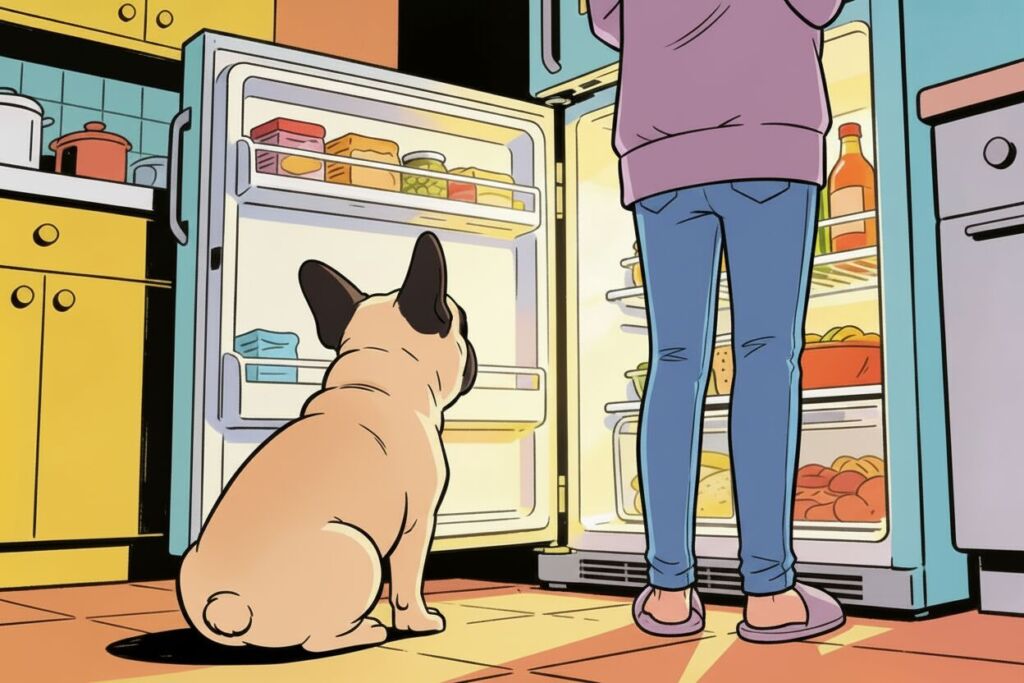
We ignore and filter out 99% of what surrounds us. Shirley Marschall looks at ad frequency, quality and why advertising strategies need to recreate the magic moment a dog hears a fridge door...
A talk show on TV, a car honking outside, music from the house next door, a phone rings, the dishwasher humming along and the dog? Sound asleep and snoring on the couch.
You tiptoe into the kitchen, open the fridge door, and out of the blue the dog is right there next to you: big eyes, all ears, wide awake.
Call it attention, selective hearing, conditioning… whatever you want. It’s not all that different from how we behave today. We ignore and filter out 99% of what surrounds us, and only the magical fridge-door 1% makes it through, really through, to us. No, this isn’t a scientific measurement but it’s close enough to lived experience to be useful.
There’s so much noise, so much distraction, so much information, and on top of it all, we’re permanently attached to a screen of some sort, constantly nudged, poked, and optimised by algorithms. There’s a desperate competition for our attention, our eyes, our ears and, ultimately, our credit cards, with everything and everyone trying to unlock the human version of the fridge door. (Saying the obvious out loud: ads on fridges are not the solution.)
That fridge door is admittedly a high bar; a silver-bullet kind of bar. And no, not everything needs to aim that high. But (and this is a very big but) that’s still no excuse for what’s happening right now. Because we already know many of the things that are definitely not fridge doors: doomscrolling, auto-scrolling, slop-scrolling, flood podcasting, and now all of the above plus AI.
On top there are ads. There’s a statistic that’s been circulating for over a decade claiming the average person is exposed to around 10,000 ads a day. It has since been debunked, and rightly so, as an ad every six seconds of our waking lives always sounded suspicious. And yet, the statistic refuses to die. Probably because it feels true.
Our feeds are saturated with ads. The airwaves, TV broadcasts, sports sidelines, team jerseys, and streaming platforms are full of them. And now AI is threatening to turn that exaggerated number into something much closer to reality.
Of course, not everything has to be special, unique or (please no) viral. And yes, humans move in herds, and so do media, advertisers, publishers, and platforms. Herd behaviour now dictates that every brand needs a social media presence, a podcast, content creation, storytelling, influencers, chatbots… ideally all of it, mixed and matched.
Why?
The polished answer is that brands need to "meet the moment" and meet customers where they are: in feeds, in chats, in search, in AI assistants.
The honest answer is simpler: because that’s just how things are done. And "how things are done" has a remarkable track record of outperforming common sense.
Still…if we could at least settle for advertising to sometimes not actively annoy people or occasionally being better than average, that would already be a first step into the right direction.
Danny Weisman, co-founder at Obsessed Media, has some suggestions for this first step: "There are different levers you can pull to make your brand more than average. It could be channel selection. It could be creative development. It could be audience focus. And it obviously extends beyond just marketing to product, price, and distribution."
That’s, unless you believe AI cranking out ads by the thousands is more helpful than strategy. Or that YouTube’s new 60-second unskippable ad formats are going to improve the public’s experience of advertising. Or that ambushing an audience is, in general, a good idea.
And Brian Jacobs, founder at BJ&A, says it out loud (someone had to): "I can’t see how a system that results in ads popping up literally mid-sentence in an interview can add anything to the viewer’s experience. In fact, it will result in losing those audience members who throw their phone at the dog in intense irritation. Whatever the highly dubious numbers, this approach is not good for viewers. Or dogs."
Ouch, another dog moment but that doesn’t sound at all like the dog-and-the-fridge-door moment we’re aiming for. Quite the opposite. Poor dogs (and humans)...
James Fleetham adds to this: "The IAB says 80% of people are OK with ads in exchange for free content. But it’s in all of our interests not to overstretch this acceptance. Recent research (fewer ads, more effective, also known as FAME) confirms what should have been obvious all along: what’s good for the audience is good for the advertiser."
Bottom line: make fewer things, but make them matter. Ambushing an audience is never a good idea. Be the print version of The Onion. Be Spotify Wrapped (but not the LinkedIn or Lidl or ChatGPT or Moonpig or a bank's cringe version, please). Or simply be the brand that knows when to STFU… a strategy that sounds radical only because restraint has become so rare.
More of a cat person? Try this one instead...
Shirley Marschall is ExchangeWire's weekly columnist - find her on LinkedIn where she's making sense of ad tech.









Follow ExchangeWire