
Life, Ads and Planet Google...
by Shirley Marschall on 11th Feb 2026 in News
Google's latest earnings are out. In her weekly column, Shirley Marschall takes a look at the tech behemoth's ubiquity and tells us what exactly an eierlegende wollmilchsau is...
6:00 AM - Gmail pushes a notification to your phone
6:47 AM - Google Calendar reminds you of your 9 AM meeting
7:20 AM - Google Maps reroutes you around traffic on Car Play
7:35 AM - Stop for coffee. Tap your phone. Google Pay.
9:00 AM - Google Meet on your notebook, in Chrome.
10:30 AM - Back to the desk. Open Google Ad Manager, DV360, and check campaign performance in Google Analytics. Review search ads in Google Ads. The entire ad stack. End to end. All Google.
1:00 PM - Lunch with your Google Sales rep
2:15 PM - Search something, or to be precise, google something.
3:00 PM - Google Docs for a shared file
5:45 PM - Ask something, or to be precise, gemini something.
8:30 PM - YouTube or stream anything you like via Google TV
Just another day on planet Google…
You’re an Apple person who wholeheartedly bought into the ecosystem? Happily paid the premium, and still can’t escape Google? Not in your personal life. Not in your professional life. Not anywhere.
Yes, even Apple couldn’t build the wall high enough. As an average Apple user, you went all-in: MacBook, iPhone, Apple Watch, AirPods. You paid the Apple tax, accepted the walled garden, and not just for its premium products but also because Apple’s entire business model is built on control, on building walls so high you never need to leave.
And yet.
You use Chrome because Safari is annoying. Tab management, extension support, speed…pick your complaint. Chrome just works better.
You use Google Maps because Apple Maps still can’t reliably figure out where you are. A decade later. Unlimited budget. Total control over iOS and default placement on every iPhone… and it’s still so incredibly painfully bad.
You use Gmail because it’s where your personal email lives, maybe your work email as well. And Gmail and Google Calendar go hand in hand… so that’s that.
Or maybe you resist Chrome and stick with Safari. Guess what Safari’s default search engine is? Google. And Apple gets paid USD$20 billion (£14.6bn) a year for that privilege.
"Hey Siri" - powered by Gemini now. Yes, Siri’s getting smarter thanks to Gemini’s brain implant doing the heavy lifting. For a tiny fee of USD$1 billion (£730.5m) annually, Google is happy to oblige.
Bottom line: Apple, the most valuable company on earth, the one that prides itself on privacy and control, couldn’t keep Google out of its own house. And if Apple can’t build alternatives that work, who can?
It’s not that you chose Google, though. It’s that everything else disappeared.
Remember Skype? It was a verb. "I’ll Skype you." Now it’s dead, gone. Google Meet didn’t kill it in some dramatic showdown; it just waited for Skype to fade, then filled the space.
Internet Explorer once had over 90% market share. Then Chrome arrived. Now, Explorer is Edge and barely existent. And Chrome has a global market share of over 70%.
The pattern isn’t that Google beat the competition. It’s that the competition evaporated, and Google is what’s left standing. In every category.
You, however, aren’t necessarily aware that you’re using Google all day. You think you’re: Checking emails (Gmail) and your calendar (Google Calendar). Getting directions (Google Maps), paying for coffee (Google Pay), hopping on a video call (Google Meet), writing a shared doc (Google Docs), storing the document (Google Cloud), watching a video (YouTube), and asking your AI assistant a question (Gemini). And the list goes on.
The branding is so fragmented it doesn’t feel like a monopoly (though some of it is officially a monopoly). It feels like a bunch of separate tools that just happen to work really well together. But it’s all Google. All of it.
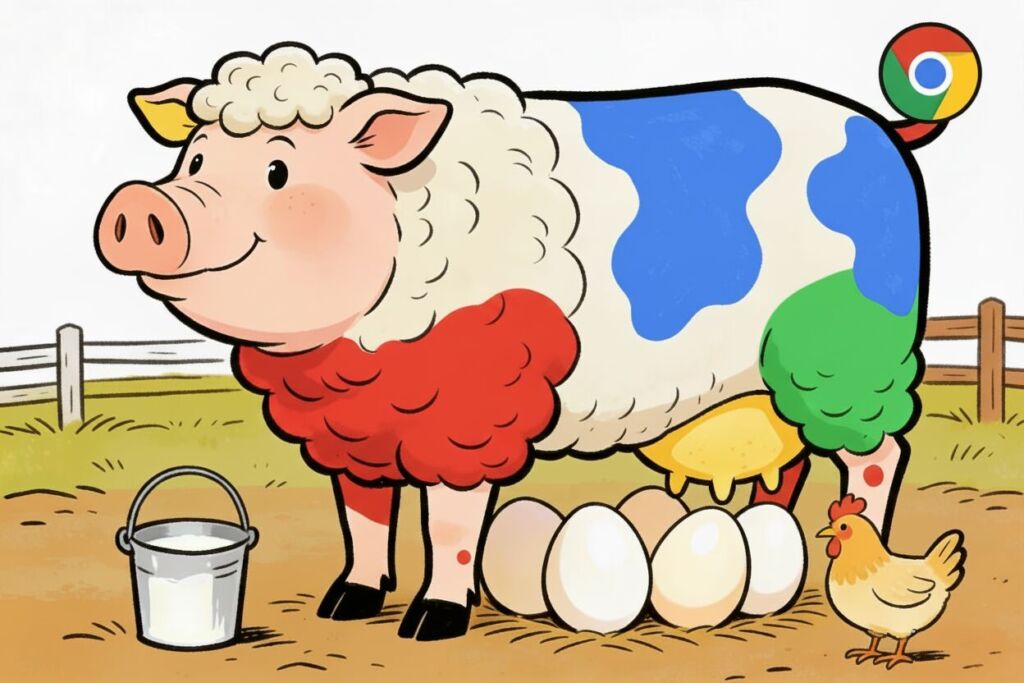
In German there’s a word for this kind of creature: die eierlegende Wollmilchsau.
Literally, the egg-laying, wool-producing, milk-giving pig, the mythical product that does everything, perfectly, all at once.
Google is the digital version of that animal. One interface for your life, one infrastructure for the internet, one stack for advertisers. And the whole thing is quietly, relentlessly sponsored by ads.
And yes, "if it’s free, you’re the product." But happily unaware, most users don’t really care. And somehow, Google is even… beloved? Not in a "we love this company" way. But in a "yeah, they’re everywhere, but my life would fall apart without them" way.
And the professional part, everyone in the ad tech industry already knows: This isn’t just personal dependency. It's infrastructure capture, as every brand trying to reach consumers is buying from the same company those consumers are defaulting to all day long. And the ad platform? Stitches all of that together…
Private or professional, one thing is clear: Google is the competitor everyone is reacting to.
Meanwhile, Alphabet/Google published its Q4 earnings last week. Beating expectations (of course) with revenue of USD$113.8bn (£814bn), 76.7% of which comes from advertising. That’s a lot of ads. And no real surprise. Which is precisely the point.
For more than a decade now, Google has trained markets, competitors, and regulators to expect the same thing: steady growth, expanding reach, and an ever-widening footprint across the digital economy. The numbers may fluctuate quarter to quarter, but the direction rarely does. Up. Up. Up.
How long will this "up" continue? My grandma used to say: Trees don’t grow all the way to the sky. Time will tell, but here are two thoughts worth exploring:
Ricky Sutton, author of Future Media, writes: "This is not a technology company that happens to sell ads any longer. This is an ad company that builds the tech to monopolise it."
And Friend of Fair Ads, Matt Stoller, has a theory of how Google Gemini will make money: "Google may be seeking to become our central planner and price setter."
If search and AI keep blurring into a single interface, do the trees keep growing or does someone finally decide they’ve grown too tall?




Follow ExchangeWire