
The Ad Tech Lawn Isn't Going to Mow Itself
by Shirley Marschall on 20th May 2026 in News
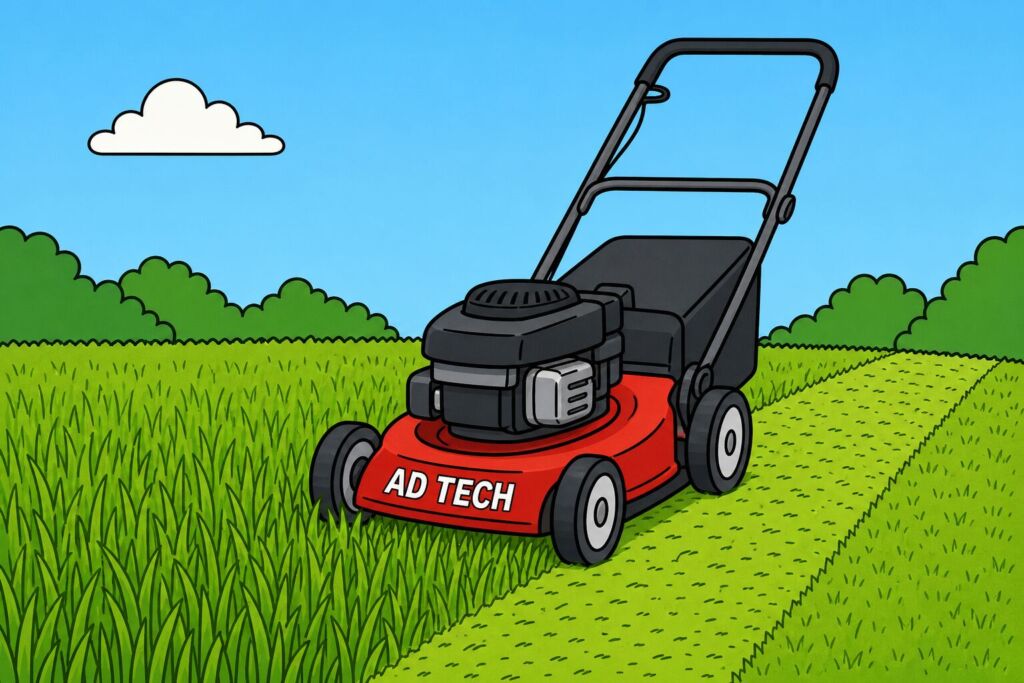
Shirley Marschall is back, and this week she's looking at why, as sure as the freshly-mowed lawn once again becomes overgrown, ad tech's problems just keep coming back...
It's May. The grass has been growing like crazy for weeks and if you've let it get away from you, you know what that looks like. Thick at the edges, uneven in the middle, and if you look closely, alive with things you'd rather not think about. Ticks. Ants. Whatever nests in neglected ground.
You get the mower out. A few hours later, order is restored. It looks good. And then, because this is how lawns work, it starts growing back.
Ad tech has the same relationship with fraud, bots, spam, scam, and slop that homeowners have with grass; It comes back… it always does.
And the industry has spent the better part of two decades being surprised by this. The silver-bullet vendor. The framework that closes every gap. The deal that cleans up supply for good. Each generation of solution arrives with confidence that this time, the problem is solved. No, it isn't. Not because the tools aren't good enough, but because the underlying condition, growth, doesn't stop. Invalid traffic finds new vectors. MFA inventory mutates rather than disappears. Spam evolves. Scam gets more convincing.
The grass is not the problem. Growth is the condition, which means quality, brand safety, and supply paths are not projects to complete, but practices to sustain. A distinction that matters more than it might seem.
Growth is the condition, which means quality, brand safety, and supply paths are not projects to complete, but practices to sustain
Projects have completion states. You scope them, resource them, ship them, and move on. Practices, however, are the never-ending story. They develop, and a good practice in January might look a lot different by September. Not (necessarily) because something went wrong, but because the environment changed and the practice adapted to it.
Getting this right doesn't mean declaring victory. The failure mode runs in both directions. Neglect creates chaos, but overcorrection creates its own problems. Aggressively optimised campaigns, ruthlessly filtered supply paths, ultra-tight measurement frameworks. They create the appearance of order. So does a system tuned so hard it's optimising against its own constraints rather than against reality.
Sorry advertisers, but ad tech isn't a peace of mind product or someone else's problem to solve. Hand over the budget, collect the report, move on? Any solution selling that kind of comfort. Run.
Ongoing monitoring, continuous optimisation, a relationship that deepens over time. That's the product. Not a one-time fix, but an ongoing practice. For once, vendors’ interest (whatever their other incentives) and the right answer are pointing in the same direction. The question is whether buyers are ready to stop shopping for certainty and start investing in relationships.
Easier said than done, as the project mentality is very persistent and deeply rooted. Partly it's organisational. Ongoing maintenance is harder to budget for than a one-time fix, harder to justify in a quarterly review, harder to champion internally when there's no launch moment to point to.
Partly it's psychological. People want problems to be solved. Accepting that some conditions are managed rather than resolved requires a different kind of tolerance for ambiguity. But… the cycle is the job.
Ongoing monitoring, continuous optimisation, a relationship that deepens over time. That's the product. Not a one-time fix, but an ongoing practice
Will AI take over this specific job? Not exactly. The optimism around AI-powered detection and verification is real and largely warranted. Models identify anomalies at scale that no human team could catch manually. Classification is faster, pattern recognition is sharper, the gap between signal and action is narrowing. But AI doesn't change the overall dynamic, it accelerates it.
Synthetic content at scale creates surface area for slop and scam that simply didn't exist before. The economics of generating plausible-looking inventory have collapsed. More content, more channels, more formats, more intermediaries. The perimeter keeps expanding.
More sunshine, more rain, faster growth on every side.
And the same AI capability that powers better detection powers better evasion. As Rocky Moss, CEO at Deepsee.io, puts it: "If you have weeds, you spray. But what happens when the spray stops working because the weeds have mutated? Do you keep buying the new formulation from the same manufacturer, or do you go a different way?"
That last question isn’t rhetorical. Vendor selection is itself a form of maintenance, one that requires the same ongoing judgment as any other part of the stack. Sitting through one too many pitches is easy to resent but might actually be time well spent. It's the only way to tell which solutions are selling easy answers vs which are rooted in reality.
Maintenance really is an all-hands problem. A burden that doesn't sit with one team, one tool, or one contract. It's distributed across the whole organisation: procurement, strategy, ops, finance, leadership. Every layer of the stack requires ongoing attention from someone with the judgment to apply it. Vendor selection is maintenance. The relationship that grows into a partnership is maintenance. The internal culture that takes quality seriously between crises, not just during them, is maintenance.
Ad tech has no shortage of genuine challenges, but they all demand the same response: ongoing, distributed, organisation-wide vigilance, shared across every function and every partner in the chain.
Adjust. Observe. Adapt. Sigh. Repeat.
Read all of Shirley's columns here, and find her on LinkedIn
Ad BlockingAd FraudAd Networkad revenueAd ServerAd Tech








Follow ExchangeWire