
Ad Fraud, an Elephant’s Grudge, and a Milchmädchenrechnung
by Shirley Marschall on 28th Jan 2026 in News
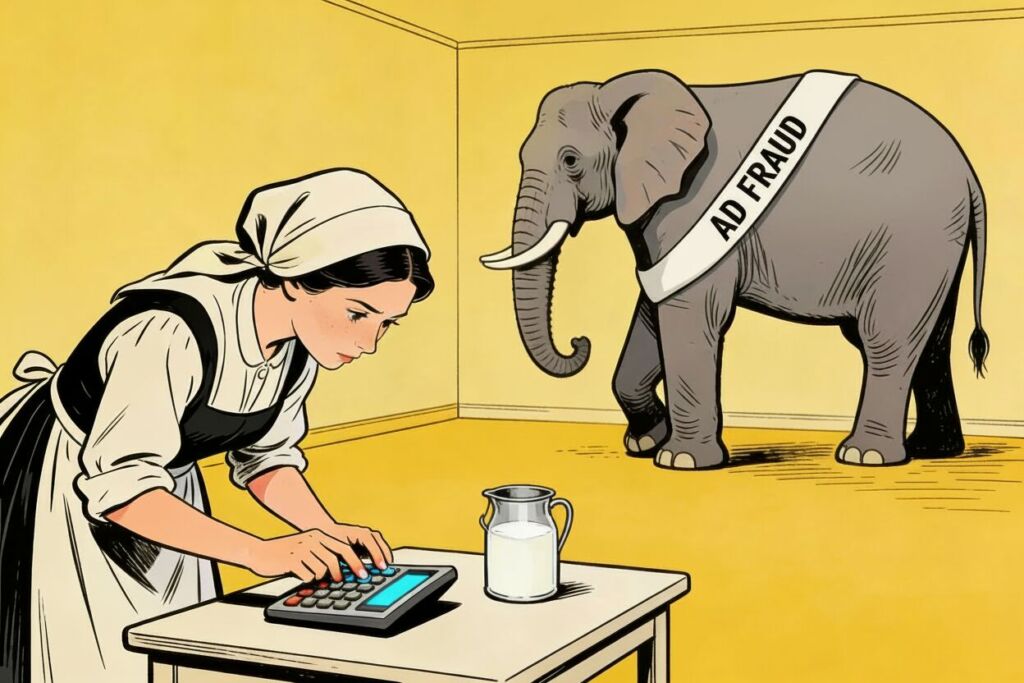
Ad fraud: a problem that advertisers constantly, conveniently forget about. Why is nothing changing? Our columnist Shirley Marschall takes a look…
Elephants, those magnificent behemoths of the wild, have long captivated our imagination with their intelligence, intricate social lives, and, most intriguingly, their phenomenal memory. They remember water sources, recognise individuals, and retain trauma, cruelty, and specific threats for decades. And they are truly masters at holding grudges.
Now imagine if the advertising industry had the memory of an elephant. Imagine if we actually remembered scandals for more than two weeks. If we held grudges. If we drew conclusions from repeated failure, acted accordingly, and held others accountable.
Instead, we forget. Constantly and/or conveniently.
USD$63bn (£46bn) wasted. That’s how much global digital ad spend was lost to invalid traffic last year alone, according to a recent report by Lunio.
Claire Atkin, CEO of Check My Ads, puts it bluntly: "This is theft. Imagine you are running a four-million-dollar ad campaign, and USD$320,000 to USD$1,000,000 (up to £728m) of it is stolen. Not just from you, but from all the places it could have gone – journalism! community events! magazines! Literally anything but tech billionaires! This is why the news is collapsing. Because middlemen tech companies have made it insanely easy for advertisers to be victims of fraud."
She’s right. And the number is staggering, with advertisers often unaware to the extent that they are victims of ad fraud. But it’s also… familiar. Because how many industry articles, LinkedIn posts, panels, and conference keynotes over the past two decades have opened with some variation of "the digital advertising industry has a fraud problem"?
Too many to count.
Bob Hoffman has been saying it for years: "We have spent almost twenty years normalising an activity that should not be normal – in fact, it should not even be legal." And yet here we are. Not just legal, but booming. Digital advertising has grown into a roughly USD$750bn (£546bn) juggernaut, largely unregulated, deeply opaque, and increasingly harmful, as groups like Check My Ads continue to document.
Cut
This is usually the point where an article turns into yet another awareness sermon. Let’s not do that. Everyone in this industry is aware of the situation. We know tens of billions are being wasted. We know fraud, misinformation, opacity, and perverse incentives are not edge cases but structural features. And yet spend doesn’t go down. It goes up.
Yes, everything is a paradox with ad fraud – advertisers are aware that it’s happening, but aren’t convinced that it’s happening necessarily to them. And so fraud has evolved from scandal to line item. Right next to "working media" and "non-working media". Like shrinkage in retail. Like breakage in logistics. An accepted cost of doing business.
Platforms report fraud rates as if they were entirely normal. Matter-of-fact. Manageable. Within acceptable thresholds. Advertisers nod along, mentally discounting campaigns before they even start. Ten per cent lost? Fine. Five per cent with a verification partner? Even better.
And this is where we enter the realm of the Milchmädchenrechnung. For non-German speakers: a Milchmädchenrechnung is a naïve, self-deceiving calculation that looks reasonable on paper but collapses under even light scrutiny. The kind that makes everyone feel smart while solving nothing.
Pay an extra five per cent tech fee, and your fraud drops from ten per cent to five. Problem solved. Or at least priced in. As someone recently put it on Substack, the tech industry is a giant rubber-band ball on the bored desk of the world. Surely adding just one more band will make it complete.
Johnathan Barnes captured the deeper issue perfectly, speaking about measurement, but just as applicable here: "Third-party validation? In ad tech, that is fool’s gold. The ecosystem is riddled with circular validation – measurement partners with revenue relationships, trade groups funded by the companies they audit. 'Independently verified' often just means someone else with aligned incentives signed off."
In other words: more black boxes won’t save us. Transparent or opaque, AI-powered or not, a system built on misaligned incentives does not fix itself by adding complexity.
So why does nothing change?
Because digital advertising is a seller’s market. A handful of massive, sticky, algorithmic platforms hold user attention hostage. Buyers tell themselves they have no real choice. Challenging the system feels riskier than quietly accepting it and easier than explaining declining sales to the C-suite. More convenient than admitting that scale and safety are often at odds. And, crucially, there is little incentive for anyone benefiting from the status quo to make the problem disappear. (Does this scenario remind anyone else of Austin Powers'Dr. Evil and his USD$100bn (£73bn) ransom request?)
Anyway, enter AI.
Look at CES. Look at Davos. The industry (and the world) is consumed by AI, agentic AI, and whatever-comes-next-AI. Long-running fights over social media harms, privacy, and platform accountability have been eclipsed by national-security and AI infrastructure debates. Social justice and climate slipped down the agenda, replaced by a new moral framing: "centre humanity", just as adoption accelerates at full speed.
No, AI isn’t the villain here. But it is the perfect distraction. Fraud is a systemic issue that will require systemic solutions. Who on earth has time and energy to deal with fraud and its ilk when a shiny new frontier exists that allows the industry to collectively move on (again)?
So yes, we care about ad fraud. We care about climate change. We care about social justice. And no, we don’t lack information, but apparently, we lack memory and the willingness to hold a grudge.
Shirley Marschall is ExchangeWire's weekly columnist - find her on LinkedIn where she's making sense of ad tech.







Follow ExchangeWire