
AI Slop and Peril for the Open Web
by Shirley Marschall on 4th Mar 2026 in News
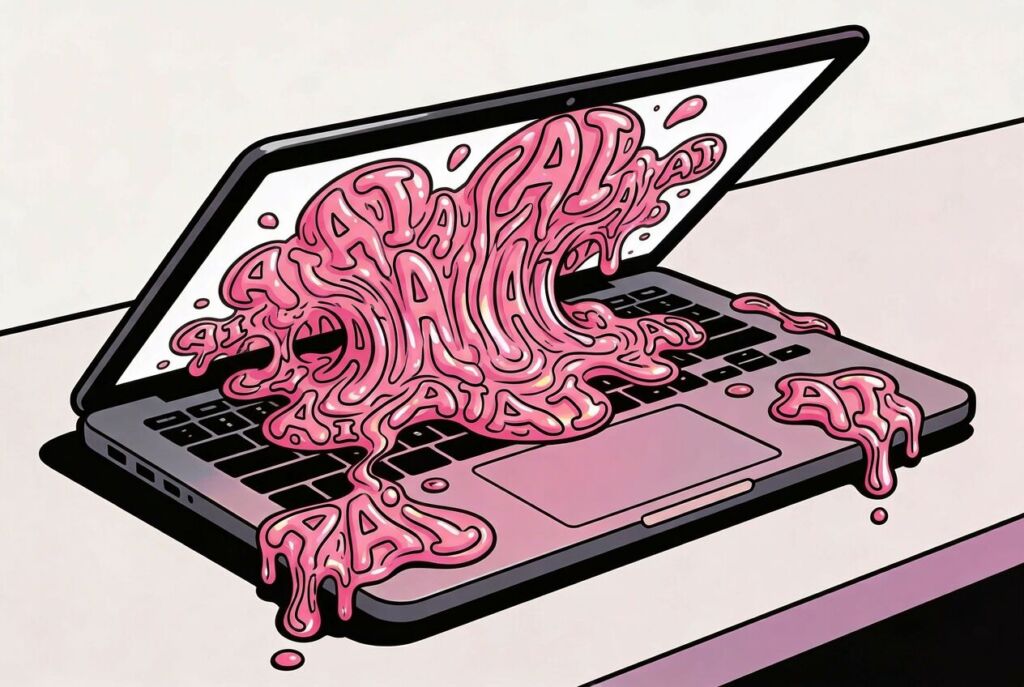
Shirley Marschall is back, and this week she's looking at the three-pronged peril for the open web in the age of AI slop...
Merriam-Webster chose slop as the 2025 Word of the Year. Google states that the open web is in 'rapid decline'. Multiple reports suggest 25-30% of open-web spend lands in wasteful or fraudulent environments.
You might shrug and ask, "What do I care?" Well, you shouldn’t… unless you care about advertisers, users and/or publishers.
Exhibit A: The Advertisers
For advertisers, the most infamous impact is wasted ad spend. Sure, there’s an acceptance that some percentage of spend will be wasted. Just like shrinkage in retail or breakage in logistics, an accepted cost of doing business. Total elimination isn't realistic and chasing perfection could cost more than it saves. But that doesn’t mean the levels of ad waste we see today are anywhere near reasonable.
And the major driver of ad waste is AI slop and there isn’t a rug on earth big enough to shove this much digital garbage under. AI slop (which almost sounds innocent) refers to professional, AI-generated content farms built with one, single objective: extract ad spend. A digital ghost town of websites, funded by advertisers yet never visited by a single human being.
In numbers: DeepSee.io’s report revealed a mind-blowing 717% increase in AI slop sites since GenAI went mainstream, bringing the total to over 100,000 sites by May 2025. Today, roughly 10,000 new junk sites are appearing every single month. No, that’s not a ghost town, that’s a megacity.
Now imagine where all this megacity money could have gone instead: in front of actual humans, yes, those potential customers advertisers were trying to reach in the first place. And while most users aren’t exactly thrilled about ads, the majority of people do accept them in exchange for free content. But that acceptance is conditional. Don’t overstretch it. Or if that’s not convincing enough, at least listen to research consistently showing that fewer, better-placed ads in quality environments outperform cluttered placements.
As Matthew Goldhill, founder & CEO of Picnic put it: "If brands and media planners can shift their approach towards prioritising ad solutions that resolve user experience issues on the web, we as an industry can drastically reduce the amount of ineffective, wasted and even damaging ad spend."
Exhibit B: The Users
In the sci-fi satire Mountainhead, one character justifies the incoming flood of synthetic garbage with this gem: "When people first went to the movies, they thought they were going to get hit by a train. The answer wasn’t to stop movies, it was to make more movies… We’re going to show people so much shit that they realise that nothing is serious anymore."
Satire? Sounds accurate enough, looking at how feeds are saturated. Doom-scrolling "evolved" to auto-scrolling and now slop-scrolling. Infinite content, increasingly indistinguishable in origin or intent. And the cherry on top is advertising.
For years, a statistic has circulated claiming the average person sees 10,000 ads per day. It has since been debunked, yet it persists because it simply feels true. Ads are everywhere and as AI lowers the cost of producing both content and ad inventory, the pressure to monetise increases further.
Meanwhile, a recent survey shows that 86% of respondents agreed that too many ads on a website makes them feel overwhelmed and more likely to ignore advertising altogether. Besides banner blindness, what’s the worst that could happen?
Well, remember the early days of digital advertising, where monetisation often came at the expense of usability: pop-ups, pop-unders, autoplay video with sound, intrusive interstitials, and sticky ads that hijacked the screen? For publishers, it was revenue. For users, it was UX vandalism until in 2015, finally the "year of the ad blocker" arrived. Users opted out. Legitimate publishers paid the price. And AI risks accelerating that dynamic at far greater scale… a sequel of the same movie.
Exhibit C: The Publishers
AI didn’t just transform search results but reshaped how monetisation works on the open web altogether. The current score: legitimate publishers lose twice. Their content gets scraped, summarised or entirely bypassed by AI systems on one side, while their inventory competes against an ever-expanding flood of junk supply in programmatic marketplaces on the other. Antonio Torres, co-founder, CTO at DeepSee.io shared some eyebrow-raising numbers: "143.5 billion impressions in one month. That’s how much AI-generated, low-quality supply hit the bid-stream in January 2025 alone."
Meanwhile, Business Insider saw its organic search traffic fall by 55% between April 2022 and April 2025. HuffPost lost half of their search referrals over the same time period. And The New York Times saw search’s share of traffic decline from 44% in 2022 to 37% in 2025.
For publishers already juggling monetisation pressure, traffic volatility, AI crawling, new SEO frameworks… that’s a lot. Add the constant worries that the declining open web and monetisation challenges are just the beginning and a shift from AI Overviews to Agentic browsers could intensify the current situation even further. Yes, that scary Google Zero scenario.
On top, low-quality domains multiply, algorithms face increasing difficulty distinguishing signal from noise. The result is downward pressure on CPMs and reduced revenue potential for publishers investing in journalism, editorial standards and user experience.
So, what can publishers do other than panic and continue watching their traffic decline? Reinvent themselves, which is admittedly easier said than done. But here we are, watching publishers pivot, adding videos, podcasts, video podcasts and debating which additional innovations could bring back their lost audience.
Nothing about AI slop is simple. The overall direction… onward but downward. Doing nothing though guarantees one thing: advertisers waste more, users get annoyed further, and publishers get squeezed even harder. A classic lose-lose-lose situation.
Shirley Marschall is ExchangeWire's weekly columnist - find her on LinkedIn where she's making sense of ad tech.









Follow ExchangeWire