
"Omnichannel planning has become a living system.": Yaron Tomchin, CEO, Mobupps
by on 17th Feb 2026 in News
We meet Yaron Tomchin, CEO at Mobupps, to discuss the omnichannel landscape and how innovation has turned media planning into a far more dynamic process…
Modern advertisers are under pressure to connect the dots across devices, platforms, and channels. In this Q&A, we speak with Yaron Tomchin, CEO and co-founder of Mobupps, about how cross-device strategies spanning mobile, web, CTV, and emerging media can drive measurable growth. Tomchin also explores the evolving role of AI agents in campaign optimisation and audience management, the renewed importance of incrementality testing, and how next-generation data management platforms (DMPs) are evolving to meet the demands of a privacy-conscious, performance-driven ad tech landscape.
What are the biggest challenges in unifying programmatic buying across different channels?
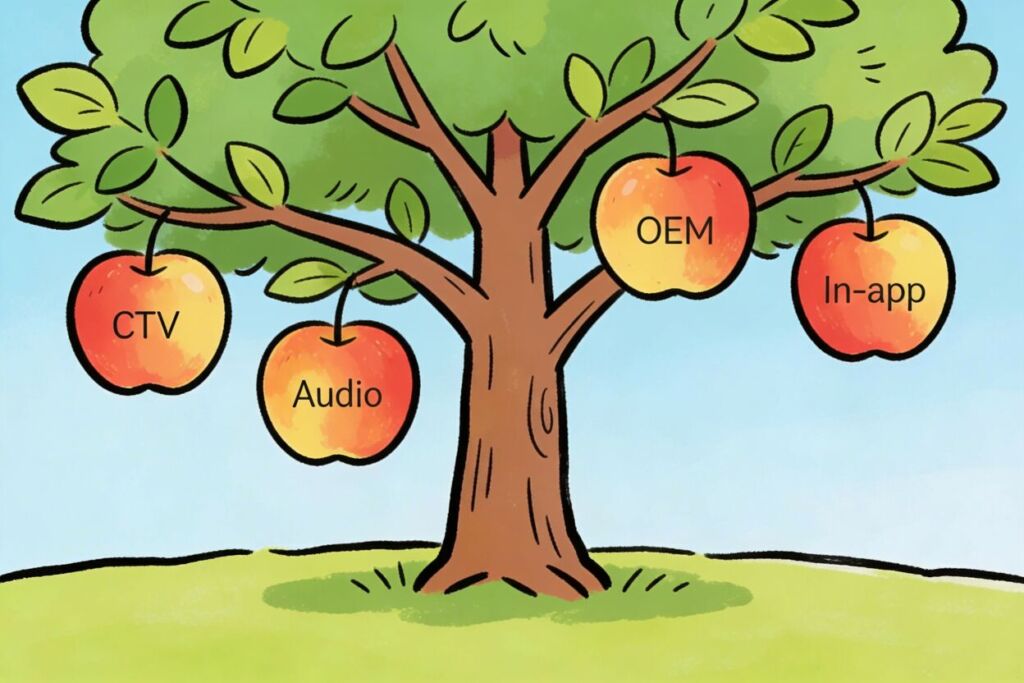
The core challenge lies in the fragmentation of decision-making. Each environment, whether mobile in-app, web, CTV, OEM inventory, or emerging formats, operates with its own identity frameworks, auction dynamics, measurement standards, and latency. When advertisers attempt to unify them, they discover that what seems like one ecosystem is actually a collection of parallel systems optimised for different truths.

Another major hurdle is signal asymmetry. Some channels are rich in deterministic signals, others rely on probabilistic or contextual inputs. When these signals are isolated, media teams are forced to optimise locally instead of globally. That leads to duplicated reach, inefficient frequency, and missed marginal gains.
Ultimately, unification requires moving away from channel-centric thinking and toward outcome-centric management. So that media decisions are made based on incremental value, not where an impression happens to be delivered.
How has the latest innovation in ad tech changed the way advertisers approach programmatic omnichannel planning?
Recent innovation has fundamentally changed planning from a static exercise into a dynamic process. Modern ad tech has turned omnichannel planning into a living system, allowing advertisers to react in near real time to performance signals across devices and formats. Advances in real-time data processing, automation, and AI have also collapsed the distance between insight and action.
Planning, activation, and optimisation operate as one feedback loop. This allows advertisers to plan around user journeys rather than media channels, adapting creative, bids, and allocation dynamically as users move between environments. For example, CTV introduces the brand, mobile reinforces intent, web closes, and OEM environments shape frequency and context.
As a result, technology supports omnichannel planning, defining which touchpoints are actually driving incremental growth, and how budgets should flow accordingly.
What signals or data sources are most critical today for effective cross-device measurement?
Effective cross-device measurement now depends on a layered signal strategy. Deterministic identifiers still matter where available, but they are no longer sufficient or scalable on their own. But combining identity signals with behavioural, contextual, and event-level data can bring the real advantage.
Key signals include first-party engagement data, conversion events, temporal patterns, creative interactions, and environment-specific signals such as device type, app category, content genre, or OEM-level inputs. Just as important is how these signals are processed. Recency, frequency, and sequence often matter more than raw volume.
Cross-device measurement today is more about probabilistic confidence at scale. The key goal is to understand patterns that reliably predict incremental outcomes across cohorts and devices.
How does incrementality measurement differ across programmatic channels, and which methods do you see as most effective?
Incrementality varies by channel’s role in the user journey. Upper-funnel environments like CTV or high-impact display often influence consideration and intent, while mobile and performance-driven channels tend to capture demand. At the same time on the web, incrementality requires distinguishing persuasion from coincidence in high-intent environments. Measuring them with the same lens leads to distorted conclusions.
The most effective approaches combine multiple methodologies: controlled experiments where possible, geo-based or audience-based holdouts, and advanced modeling to fill the gaps where experimentation isn’t feasible. Incrementality should be evaluated at the system level with consistency in measurement logic. This mindset shifts optimisation away from last-touch efficiency and toward true business impact.
Where can data management platforms come into play?
Modern DMPs play a very different role than they did in the past. Data management platforms act as the operational intelligence layer that brings order to complexity. A well-designed DMP connects first-party data, media exposure, contextual signals, and modeled insights into a single, usable system. It enables dynamic audience definition, cross-channel frequency control, and post-campaign learning that actually feeds back into buying decisions. In a fragmented omnichannel world, a DMP becomes the foundation for incrementality, frequency governance, and cross-device learning.
More importantly, the DMP turns into the organisation's precise memory. It captures what worked, under which conditions, and why, turning campaigns into compounding knowledge rather than isolated events.
Building on that, where can agentic AI come into play?
Agentic AI represents the next operational leap. Instead of humans manually interpreting dashboards and executing optimisations, AI agents can actively manage objectives, including adjusting bids, reallocating budgets, testing creative, and learning from outcomes autonomously within defined constraints.
In a cross-device context, AI agents excel at handling complexity and volume that humans can’t scale. For example, thousands of signals, multiple time ranges, and constantly shifting environments. And they optimise for incremental contribution at the system level.
Crucially, agentic AI also changes how teams work. It reduces operational friction, surfaces insights faster, and allows human expertise to focus on goals, ethics, and growth decisions. When combined with a strong data foundation, agentic AI turns omnichannel programmatic into a learning system. And that’s where the future lies – in smarter machines.

Mobupps
AICampaignCross-DeviceMeasurementOptimisation







Follow ExchangeWire