
The Zombie Industry: How Publishers Keep Surviving Their Own Death
by on 24th Feb 2026 in News
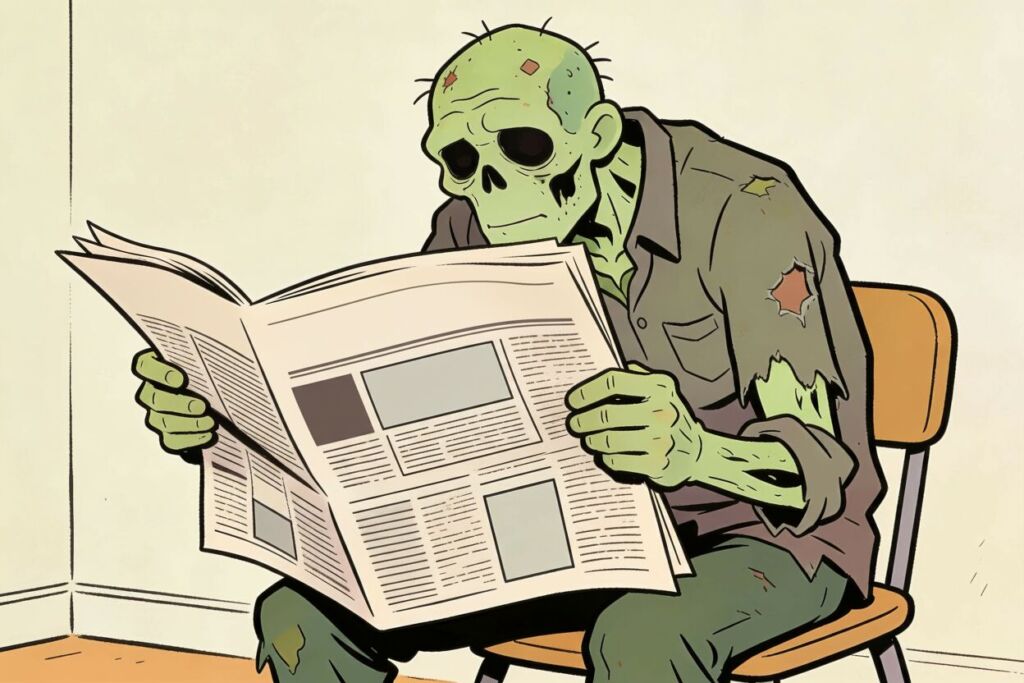
Strategist, founder and creative operator Alanna Laforet looks at the long-rumoured demise of publishers, and how they survive because of tech innovation, not despite it...
They've been killed more times than a horror movie villain. Radio would destroy them. Television would finish the job. The internet was supposed to deliver the final blow. And now artificial intelligence is being positioned as the ultimate extinction event. Yet publishers, those supposedly antiquated gatekeepers of content, remain stubbornly, infuriatingly alive.
This is not a story about lucky survivors or technological holdouts clinging to the past. This is a story about one of the most misunderstood dynamics in media. It explains why organisations that control original content creation possess a resilience that repeatedly defies predictions of their demise. The pattern is now more than a century old, yet each generation of disruption prompts the same confident obituaries.
The truth is counterintuitive. Publishers do not survive despite technological innovation. They survive because of it.
The Century of Premature Obituaries
When radio broadcasting emerged in the 1920s, newspapers faced what seemed like an existential threat. Why wait until morning to read yesterday's news when you could hear it instantly? The medium seemed perfectly designed to render print journalism obsolete. Radio offered immediacy, personality, and the human voice. These were all things newspapers lacked.
But newspapers did not disappear. They adapted. Unable to compete for national advertising against radio's massive reach, publishers pivoted to become indispensable local institutions. They became monopolies in their communities. They were the only source of local news and the only viable advertising option for Main Street businesses. In many cities, the sole surviving newspaper achieved profit margins of 20 to 40 percent. Those numbers would make tech companies envious.
Television arrived in the 1950s and the cycle repeated. Moving pictures with sound would surely finish what radio started. Instead, newspapers survived again and further entrenched their local dominance while television fought over national audiences. By the time the internet emerged in the 1990s, newspapers had weathered two supposedly fatal disruptions and emerged profitable each time.
Each premature obituary shared the same flawed assumption. It assumed that distribution technology determines content value. Distribution has never been the publishers' core asset. Content creation at scale has always been the core asset.
The Content Monopoly Advantage
Publishers possess something that technology platforms cannot easily replicate. They have the institutional capacity to produce original content reliably and at scale. This is not about individual journalists or creators. Those are abundant. It is about the organisational infrastructure that can deploy investigative teams, maintain beat reporters, enforce editorial standards, handle legal review, and publish daily across multiple verticals simultaneously.
Consider The New York Times, the archetypal example of publisher resilience. Founded in 1851 and older than the telephone, the lightbulb, and the automobile, it has survived every communications revolution of the past 173 years. As of the third quarter of 2024, the Times reported approximately 11.09 million subscribers across print and digital products. Digital-only subscribers comprised the vast majority. This is not a zombie barely clinging to life. It is a thriving media company that has successfully transformed its business model while maintaining its core function.
The digital transformation of legacy publishers reveals a crucial insight. Aggregators and platforms still need someone to create the content they distribute. Google Search needs articles to index. Facebook needs posts to populate feeds. AI language models need text to train on. The technology changes how content flows, but it does not eliminate the need for content origination.
This creates what economists would call a complementary relationship. New distribution technologies often increase the total demand for professionally created content, even as they disrupt the business model that previously funded that content. The problem publishers face is not obsolescence. The problem is capturing sufficient value from the expanded content consumption their work enables.
The Extraction Period: Funding the Pivot
One of the most underappreciated aspects of publisher resilience is their ability to use profits from legacy businesses to fund digital experimentation. The New York Times generated over $750 million from print operations in 2023, which was roughly one-third of total revenue. This cash flow provides the runway to experiment with new products, acquire digital assets, and weather the transition period while building sustainable digital revenue.
This extractive-period strategy allows publishers to fail repeatedly without existential consequences. The Times tried TimesSelect, which was a failed early paywall. It tried various apps, multimedia experiments, and numerous product launches that went nowhere. Most startups would have died after two or three such failures. Publishers kept trying because print advertising continued funding the experimentation.
The strategy works because publishers are not trying to maintain their old business. They are using it as a bridge to a new one. They accept declining print revenue as inevitable, but manage the decline slowly enough to build replacement revenue streams. It is controlled demolition rather than catastrophic collapse.
Beyond News: The Platform Evolution
Perhaps the most significant adaptation has been the transformation from single-product news organisations to multi-product content platforms. The New York Times now offers Games ( the purchase of Wordle was genius), Cooking, Wirecutter product reviews, and sports coverage through The Athletic. These additions are not peripheral. They represent a fundamental reconception of what a publisher is.
This diversification creates multiple revenue streams and reduces dependence on news, which has always been expensive to produce and politically contentious. It also creates different subscriber acquisition funnels. Someone might subscribe for the crossword puzzle, discover the recipe section, and eventually start reading the news coverage. Each additional product increases the total addressable market and the likelihood that the subscription becomes indispensable.
Successful publishers in 2024 look less like newspapers and more like consumer subscription platforms that happen to include news. This is not abandoning their core mission. It is recognising that the bundle has always been the product, and the bundle can include whatever creates value for subscribers.
Another successful evolution can be seen at The Wall Street Journal, which has expanded beyond its core subscription business into a robust business-to-business events and executive convening strategy. Through CEO councils, global forums, industry summits, and policy conferences, the Journal monetises its authority and audience by bringing together corporate leaders, policymakers, and sponsors in high-trust environments. These events generate sponsorship revenue, deepen subscriber relationships, and reinforce the publication’s role as a central node in business decision-making networks. Rather than treating journalism as a standalone product, the Journal leverages its editorial credibility to create adjacent revenue streams built on access, insight, and convening power. This approach reflects how modern publishers increasingly monetise influence and audience, not just articles.
The Trust Moat in an Era of Abundance
The internet created a curious paradox. It democratised content creation while simultaneously making trusted sources more valuable. When information was scarce, any source had value. When information became abundant, curation and verification became the scarce resource. Publishers that maintained editorial standards found that their brand credibility became a competitive advantage in the digital age.
This is particularly visible in the rise of misinformation and the response to it. Readers increasingly seek sources they can trust to verify claims, fact-check assertions, and maintain journalistic standards. The institutional apparatus that seemed like overhead in the print era, including fact-checkers, editors, and legal review, becomes valuable differentiation when competing against algorithmically ranked content of unknown provenance.
Publishers did not create this dynamic intentionally, but they have learned to leverage it. Premium subscription models work because readers are willing to pay for trusted information in a way they were not willing to pay for commodity news. The brand equity built over decades of publishing suddenly has commercial value in digital markets.
The Failures That Prove the Rule
Not all publishers survived, and the failures are instructive. Local newspapers without strong brands or monopoly positions collapsed rapidly. Papers that tried to maintain print-era cost structures without print-era revenue streams failed. Publishers that treated digital as an afterthought rather than a transformation project failed. Pure print holdouts that refused to adapt failed.
The pattern in the failures is telling. Publishers that survived were those that recognised they were in the content business, not the paper business. Those that failed confused their distribution method with their core product. The medium was never the message. It was just the delivery mechanism.
This distinction matters because it explains why some publishers thrived while others died under identical external pressures. Technology did not determine the outcome. Strategic choices about product, pricing, and positioning did. Publishers with leadership that understood this distinction could navigate the transition. Those without it could not.
The Next Disruption: AI and the Pattern Repeats
Artificial intelligence is now being positioned as the technology that will finally kill publishers. AI can summarise articles, answer questions, and generate content without requiring the user to visit publisher websites. Why would anyone subscribe to a newspaper when an AI can instantly synthesise information from multiple sources?
This reasoning repeats the same error made about radio, television, and the internet. It assumes that distribution efficiency determines content value. It ignores that AI models are trained on publisher content, making publishers the ultimate source of the information AI provides. It overlooks that readers increasingly value authoritative sources precisely because AI makes it trivial to generate plausible-sounding nonsense.
More fundamentally, it misunderstands what publishers sell. They do not sell access to information. Information is abundant and often free. They sell verification, curation, original reporting, investigative journalism, and the brand assurance that what you are reading is accurate and important. These are exactly the things that become more valuable as AI-generated content proliferates.
Publishers will adapt to AI the way they adapted to every previous disruption. They will experiment with AI tools for content production. They will develop new products that leverage AI capabilities. They will negotiate licensing deals for their content to be used in AI training. They will continue producing the original content that AI systems depend on but cannot create.
The Resilience Mechanism
The pattern across a century of disruption reveals a consistent mechanism. Publishers survive because each new distribution technology increases total content consumption while disrupting only the business model, not the fundamental need for content creation. The result is a repeated cycle of crisis, adaptation, and eventual stabilisation at a new equilibrium.
What looks like stubborn resistance to change is actually sophisticated organisational adaptation. Publishers that survive maintain their core capability of creating trusted content at scale while continuously evolving how they package, price, and distribute that content. They use profits from legacy businesses to fund experimentation. They diversify into adjacent content verticals. They build brand moats based on trust and quality. They accept managed decline of old revenue streams while building new ones.
This is not a story of individual brilliance or lucky timing. It is a structural advantage that comes from controlling the source of original content in a world that consumes exponentially more content with each technological advance. As long as audiences want reliable information about the world, someone needs to gather it, verify it, contextualise it, and publish it. Publishers have spent centuries building the institutional capacity to do exactly that.
The next time someone predicts the death of publishers, remember that the prediction itself is part of the pattern. The technology threatening publishers this time is different, but the underlying dynamic is the same. New distribution creates new consumption, which requires new creation, which publishers are positioned to provide. As I write this, Warren Buffet just pumped $350 million into The New York Times after divesting from publishing six years ago. Content remains king, and publishers remain the kingmakers.
They have survived radio, television, and the internet. They will survive AI too. Because the business they are really in, creating original content that people value, is more essential than ever.
Ad NetworkAd TechAdvertiserAgentic AIAIPublisher







Follow ExchangeWire