
Agentic Advertising Needs Interoperability, Standardisation, and Adoption to Thrive
by on 17th Apr 2026 in News

Jonas Jaanimagi of IAB Australia gives us his thoughts on how the ad industry can truly realise the promise of agentic advertising...
As an industry, we’ve progressed over the past 25 years from basic enablement through to enhanced addressability. From manual processes to header bidding, while always pursuing the full embrace of genuinely meaningful automation. Still too many processes remain overly clunky, and navigating fragmented technologies can feel painfully manual. The digital advertising ecosystem is now navigating a potentially pivotal transition from deterministic, human-mediated programmatic systems to a more autonomous, agentic architecture. The emergence of agents as now being capable of reasoning, planning, and executing marketing workflows could soon be reshaping the related processes and interactions at impressive speeds.

However, as promising as this all sounds, without some sensible planning we do risk creating a noisy AI mirage, from which understandable concerns of a dystopian takeover by machines emerge. Within grasp is the opportunity to achieve genuine liberation from the drudgery of manual administrative processes and freeing us all up to focus more intently on the work that humans should be doing more of. For us to plan ahead coherently for agentic capabilities as they move from development environments into production, we need to ensure that we can allow for full interoperability, have guardrails established through standards and have a 'full court press' globally on adoption.
Reassuringly, the more that I review the IAB Tech Lab's newly launched agentic advertising initiative (now released under an umbrella project called AAMP - Agentic Advertising Management Protocols) the more that I am reassured that we are on the right path as an industry. AAMP and its various protocols, APIs, schemes and tools are evolving quickly into the infrastructural overhaul that we have been waiting for, by striking a balance between familiar operational standards and conventions whilst also fully leveraging the capabilities of agentic. AAMP exists to provide the full set of agentic specifications, protocols, frameworks, and reference implementations some of which have been released, and some are currently still under development and advancement.
Already accelerating with significant momentum, this project is pragmatic in nature as a standards-driven revolution that can lean upon the hard-won wisdom of billions of daily transactions over to autonomous agents in a language that can be clearly understood, governed, and executed upon. What is now required is for industry to unite around this project, understand the philosophy of open-source enabled interoperability that underpins it, and work collaboratively towards widespread adoption.
Why Standards Matter in an Agentic World
AAMP is not demanding a full mandatory rebuild, but rather a smarter approach of 'agentifying' the critical standards (such as OpenRTB, OpenDirect, and AdCOM) that have served us so well for so long. Recent releases, such as the Deals API, also fit seamlessly into the mix, giving our industry meaningful and workable options as to how they wish to interact, negotiate, and execute with interoperability, governance, and human oversight very much in mind. The IAB Tech Lab’s intentionally collaborative model based upon long-adopted standards can prevent fragmentation, and set-up ad tech for sustainable growth amid evolving consumer behaviours and aggressive AI integrations. Additionally, within regulatory contexts, standards can bridge gaps by aligning with global privacy frameworks to ensure compliance without stifling creativity.
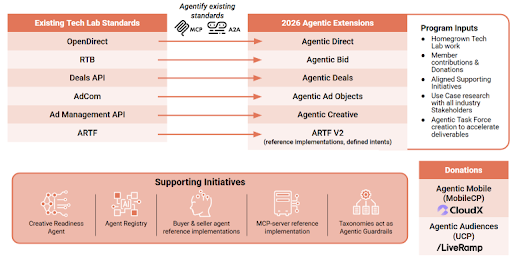
Above the foundation of ad standards rests the now well established two core agentic interoperability protocols, MCP (Model Context Protocol) and A2A Agent-to-Agent protocol). These are being leveraged in order to create secure and shared communication layers that can enable buyer agents to discover inventory, negotiate deals, and activate campaigns. Sellers, meanwhile, can deploy yield-optimising agents to minimise any unsold impressions by dynamically negotiating direct deals, mirroring the past successes in header bidding evolutions, without the related negative impacts of latency and wrapper limitations.
Enabling Trust Through Transparency: The Agent Registry
The Agent Registry launched in March 2026 and may be the single most important component of the entire initiative. It is fully open and publicly available to all within the IAB Tech Lab Tools Portal, and the intention is to provide full and neutral transparency by establishing a trusted framework for agent identity and verification. Every company can publicly register its agents and provide the discoverability and transparency exactly in the same manner, for both humans and machines, that ads.txt and sellers.json has been successfully providing for domains and supply paths for years now.
Users can easily browse any registered Agents, filter them by category, review their defined purpose, understand their capabilities and how to connect with them.
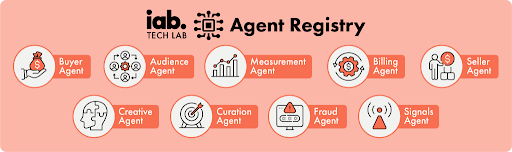
This ensures that ecosystem participants can confirm the identity and capabilities of the agents they are transacting with, building trust and reducing the risk of fraudulent autonomous activity. For governance requirements this approach for agents smoothly aligns with existing measurement, transparency, safety, and accountability mechanisms – and importantly provides capabilities for potentially enforcing best practices that obligate full operational clarity between transacting parties.
No black boxes or ambiguity, and importantly a solid foundation for industry to build upon in order to establish frameworks for governance and human oversight as agentic activities proliferate.
The Importance of Full Interoperability
A key element of the open-source philosophy is to enable all and any AI agents to participate in a dedicated registry and handle media buys, creative builds, and signal activations through unified interfaces layered onto MCP and A2A. Any structured frameworks or protocols for tasks for discovery, comparison, negotiation, and campaign management can seamlessly feed into AAMP and future open-source implementations.
A commitment to full interoperability and a willingness from the entire industry to align with, and collaboratively contribute to, the IAB Tech Lab’s roadmap must be an imperative. A fused ecosystem where any domain-specific schemas can enhance the IAB Tech Lab’s foundational object models, and free up agents to seamlessly traverse workflows is the intention. All running with the collaborative oversight of a dedicated non-profit consortium that can accelerate adoption whilst also preventing any vendor lock-ins that still plague so many.
For agentic to thrive and fulfil its promise, all and any agents emerging from the various projects, for example AdCP (Ad Context Protocol), should be registered with the IAB Tech Lab Agent Registry, commit to full transparency and be seamlessly discoverable by all. Standards organisations can act as pivotal bridges and facilitate dialogue between innovators and policymakers. IAB Tech Lab has long exemplified this by developing frameworks that address regulatory demands with enhanced privacy controls whilst still empowering software that can interact with both machines and humans alike.
A Full-Court Press for Adoption
To fortify our industry's future, active engagement from all parts of the eco-system will be essential. The AAMP initiative is an open invitation, not a finished product, and its success will be driven by the same collaborative spirit that has transformed our industry over the past 25 years. In local markets this means contributing to open-source repositories, participating in collaborative working groups, and working to implement and test the standards that will grow the collective footprint.
Much of this will be overwhelming for some, and we can learn from the past. The programmatic revolution has too often been misrepresented and caused confusion when treated as being something more than a mere mechanism and set of tools for automation and data enablement. Hence planning ahead, being open through learning together as agentic evolves and always keeping 'humans in the loop' will be critical. Brands, creatives, and strategy professionals can’t be kept at a distance in these early stages which naturally are dominated by the technically minded types. As with any form of transformation clear communication, regular consultations, and trying to bring everyone along for the journey is paramount.
Success for stakeholders will depend on adopting standards that provide both the slow thinking of strategic allocation and the fast thinking of real-time transactional delivery. In the long term, the proposed transformations within the AAMP project feel tangible. No more weeks lost translating campaign briefs into DSP targeting attributes. No more endless reconciliations of log-level data or wondering whether an optimisation layer is potentially hallucinating segments. Instead, we get natural language briefs executed with repeatable accuracy, grounded in the familiar object models and taxonomies that currently power standards such as OpenRTB, OpenDirect, and AdCOM.
Overall, the Benefits can be Widespread
The benefits should quickly cascade for all participants. Media planning and buying cycles should compress dramatically and the ease of surfacing of nuanced connections between customer segments and publisher inventory hugely enhanced. Direct deals, which have historically been bogged down by clunky processes and endless back-and-forth can now be negotiated and activated in minutes through the agentic extension of OpenDirect and enriched in real time by the newly released Deals API and the low-latency Agentic RTB Framework (ARTF). Fewer unsold impressions, smarter yields, and revitalised direct channels for sellers should result.
For buyers in particular, the potential workflow upgrades are impressive:
- Faster Execution: Media planning and buying cycles should compress dramatically.
- Smarter Discovery: The ease of surfacing of nuanced connections between customer segments and publisher inventory is hugely enhanced.
- Natural Language Activation: No more weeks lost translating campaign briefs into DSP targeting attributes. Instead, buyers get natural language briefs executed with repeatable accuracy, grounded in familiar object models.
- Frictionless Direct Deals: Deals that have historically been bogged down by clunky processes and endless back-and-forth can now be negotiated and activated in minutes through the agentic extension of OpenDirect.
For tech vendors, open-source reference implementations will allow teams to focus on innovation instead of endless custom integrations, enabling the entire supply chain to become much more interoperable and transparent.
With the agent registry in place the opportunity to take the fight against fraud from the defensive to the offensive is my personal hope. We’ve been playing catch-up and often ignoring the true facts related to this issue for too long now and having the chance to reset the playing field with fraud front-of-mind rather than an after-thought, really feels like a golden opportunity.Ironically, in programmatic we’ve been trying to avoid non-human traffic for all these years and now it just might be the bots that helps us to effectively manage media quality and establish trust between humans, whilst executing at the speeds we have always aspired to.
Agentic AIAutomationIndustry BodiesLegislation



Follow ExchangeWire