
From AI Travel Agents to Creator Technology: Exploring 2026’s Ad Tech Trends
by on 27th Apr 2026 in News
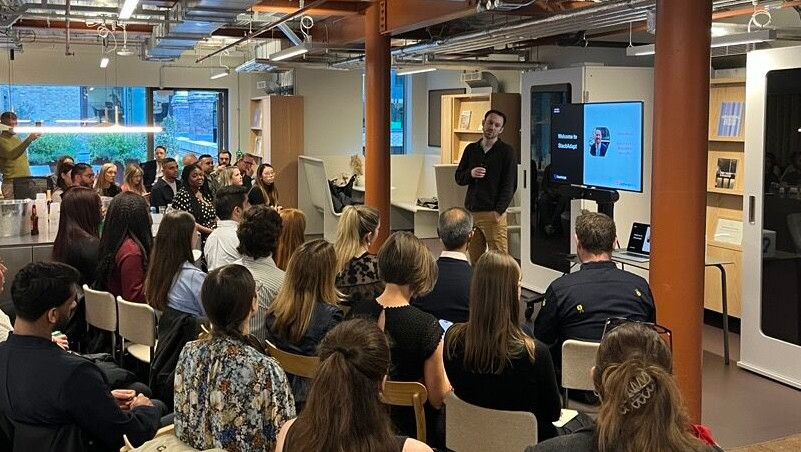
We cover the latest event held by AdTech Connect, an industry initiative created with the goal of informing and creating opportunities for the next generation of ad tech professionals.
With five events now under its belt, the AdTech Connect initiative is establishing its place in the industry. Last week, those looking to immerse themselves deeper into the world of ad tech gathered for another evening of industry talk and making new connections.
This time, a new format was introduced: five industry experts were each given a time limit of five minutes to convince the room why their trend would be the biggest in 2026, with topics spanning the rise of AI travel agents, programmatic OOH, sell-side decisioning, algorithmic buying, and creator technology.
Let’s recap the arguments, then you can make your own judgement.
Travel media: AI as your new travel agent
First up was Yasser Hussain, enterprise account director at StackAdapt. Hussain set the scene for the audience, discussing the magnitude of the travel industry, last year worth a staggering USD$12tn (£8.88tn). He described how the current geopolitical situation is impacting where consumers are deciding to take their tourism, and the rising prices of air travel. “Ad tech can play a really important role in influencing those decisions,” Hussain commented.
Now, we’re seeing the rise of AI as travel agents, which has massive implications for the industry. Hussain expands on the rise of people using LLMs to help them arrange and book their travel plans, with 2% of users on ChatGPT, Gemini, and Claude going on to book travel directly.
He made the case that brands need to be part of the “digital shelf” for AI to pick and search from. For many travel brands, B2A (business to agent) has become another core strategy, alongside B2B and B2C.
Programmatic OOH: The missing ingredient for omnichannel campaigns
Next against the clock was Mark Halliday, JCDecaux’s director of programmatic, to shine the spotlight on programmatic out of home (POOH) and discuss why it’s the missing ingredient for most omnichannel campaigns.
With consumers expecting such a high number of ads on most digital formats nowadays, many do what they can to avoid them. Millions pay for the ad-free tiers of streaming services, most choose to skip skippable ads, and many use ad blockers online. OOH can’t be skipped, and according to research, people generally like seeing OOH ads. They often remember the ones they see, too.
Why is OOH so effective as part of an omnichannel campaign? According to Halliday, “when you see an ad everywhere and then you see it on a screen, you’re much more likely to click on it, to view it, to listen to it.” He continued, “Time and time again, we’re seeing cheaper cost per acquisition and better metrics when OOH is in the mix.” He believes that when you put OOH into an omnichannel campaign, it makes other channels work harder.
The digital out of home (DOOH) and programmatic out of home (POOH) markets are growing rapidly. By taking a programmatic approach, advertisers can gain closed loop measurement, ensure much higher audience accuracy, make use of more creative templates, achieve more efficiency when it comes to proximity to retailers, as well as scale internationally.
Sell-side decisioning: Creating a more transparent and efficient ecosystem
Leaning deeper into programmatic, Cadi Jones, SVP EMEA at Index Exchange, argued that sell-side decisioning is the biggest trend of 2026.
She recapped the history of sell-side decisioning, going over how most of the value creation in programmatic (elements like data activation, optimisation, and brand suitability) over the past decade or so has taken place on the buy-side. The sell-side has held more of a commoditised role, primarily focused on infrastructure and execution rather than strategy. This resulted in a lopsided ecosystem, which led to increased costs, publishers lacking visibility, and slowed innovation.
Now, however, the tables are turning on traditional roles. As a result of advancements in cloud infrastructure, parallel processing, and edge computing, a new window of opportunity has been located: not the full 200 milliseconds of the ad auction, but just 10 milliseconds.
What used to happen in this time included confirmation that the impression came from a human (not a bot), the scrubbing of invalid traffic, and the verification of the environment and impression. Now, much more becomes possible. Within this 10 millisecond moment, intelligence can be applied earlier in the auction, smarter decisions can be made before a bid, and new potential for sell-side activation can be unlocked.
One of the biggest advantages of acting earlier in the auction is gaining access to rich data and massive scale. This unlocks capabilities which were once difficult to push down to the DSP.
The overarching goal is to get the buy and sell side working together to achieve greater market efficiency, and to form an equitable balance between both. Sell-side decisioning is “doubling what’s possible in this industry,” according to Jones. “You get an entire ecosystem that’s more transparent, more efficient, and more innovative.”
Algorithmic buying: Continuous optimisation towards business outcomes
Fourth to present to the room was Michelle Preusch, VP sales, EMEA at Chalice AI, discussing algorithmic buying.
Beginning her argument, she introduced an analogy: programmatic as a plane on autopilot. “When autopilot first came out, it was a very novel concept. Keeping a plane in the air, flying steady at the same speed, with very little human intervention. That sounds like a great concept – similar to programmatic,” Preusch said.
Programmatic executes brilliantly – like autopilot keeps the plane in the air – but it doesn’t know where you’re going, and if the conditions change, it can’t navigate effectively. Programmatic optimised for the flight, for impressions, viewability, and click-through rates, and forgot about the destination: business results, and real outcomes.
On the other hand, algorithmic buying knows where the plane needs to land. It calculates in real-time and gets consistently smarter. It continuously optimises towards a real business outcome.
Before, algorithms were limited to a one-size-fits all approach. Now, however, custom algorithms can be made from data signals specific to a brand and their exact requirements. Preusch explained that these algorithms need to be created with only one brand in mind.
Building on this, these data signals can be put into the sell-side for even more intelligent decisioning.
Creator technology: An entire ecosystem shift
The final speaker of the evening was Matt Barash, Nova Studio’s chief commercial officer. Barash made the argument that creators have long been seen as a tactic on the edge of media plans and that this framing is now broken. Consumer attention is held by people we follow and voices we trust. Consumers value authenticity, relatability, and relevance.
To imagine the scale of opportunity: creators are producing 20,000 times more content than Hollywood each year. Billions in spend are shifting towards creator-led content, not just for awareness, but for performance. Moreover, this spend isn’t just sticking to social media; it’s flowing into channels like CTV, online video, and programmatic display. The best marketers are using social media to identify which creator-led assets resonate and drive engagement, then adapting these signals for CTV, the open-web, and beyond.
“The shift to creator isn’t just changing content, it’s changing how the entire ecosystem operates,” Barash stated. Creator audiences are scaling beyond platforms, allowing marketing to integrate into content people care about. “Creative strategists are starting to think more like media buyers,” he added.
We’re finally seeing the creator world converge with ad tech.
Following a vote, Mark Halliday came away the victor. Who is your winner? Let the team know on LinkedIn @AdTech Connect.
Ad TechAICreator economyEventsMedia buyingProgrammatic





Follow ExchangeWire