
The Trust Mechanic: Why APAC's Social Commerce Won't Follow the US into an AI Content Flood
by on 4th Aug 2026 in News

Charlotte McEleny looks at the demand for authenticity, and what brands stand to lose if they lean on synthetic content in a channel built on human trust...
At ATS Singapore last month, agency leaders came together on a panel to discuss how AI was shaping the creator landscape from an authenticity perspective.
The panellists gave a two-sided coin on AI’s influence, firstly arguing that it had a valid role in connecting a fragmented, challenging landscape for marketers from an operational standpoint. But secondly, they stated that Southeast Asia’s social commerce audience craves authenticity and experience, so synthetic content doesn’t perform as well as real people.
Not long after this, the Wall Street Journal reported AI-generated videos flooding TikTok Shop in the US, so this gave us a prime excuse to ask some of the panellists if this same wave is heading for Southeast Asia, and what brands stand to lose if they lean on synthetic content in a channel built on human trust.
The Wall Street Journal article described synthetic demos siphoning commissions from human affiliates and at least one brand, SharkNinja, banning AI content outright. Southeast Asia is where TikTok Shop is largest and where live and affiliate selling dominate, so the question for anyone selling in Asia is whether that trajectory is heading east.
The platform's own tools, from an AI Video Maker to its Symphony suite, are making shoppable content cheaper and faster to produce, and in the US they are projected to help Shop sales reach around USD$23bn (£17.1bn) this year. The premise does not translate cleanly to this region, though.
Arshad M, head of content at Omnicom Media, says the direction is right even if the picture is not. "I think it holds directionally from a perspective, but I wouldn't say we're seeing exactly the same phenomenon in Southeast Asia today. AI-generated selling assets and virtual influencers or synthetic talent are definitely growing. But creator commerce here is still fundamentally human-led."
The reason is trust, built into how the region shops. "Particularly in markets like Indonesia, Thailand, and Vietnam, people aren't just watching someone hold up a product," Arshad explains. "They're actively looking for a dialogue, asking questions, watching demonstrations, reading the comments, and interacting with sellers. That human interaction is part of the conversion mechanic." Live commerce is already industrialised and cheap here, so AI, on his reading, "will initially scale around the human rather than simply replacing the human."
Penelope Siraj, senior partner, planning at Brainlabs, frames it through monetisation. "Southeast Asia creators typically monetise their sales channels via live selling where the human hosts talk for hours and take live questions to build relationships and repeat viewers," she says. "While scaling using AI to assist can be done, and we are seeing an appreciable increase, it is still not replacing live streaming yet."
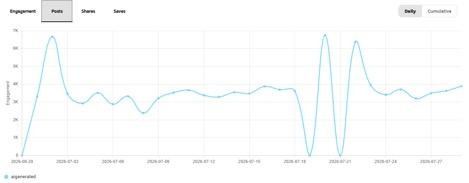
According to Brainlabs' social listening tool Bytesights, content tagged as AI-generated across Asia reached 25.3k posts in the last seven days and 102.3k over 30 days, a growth rate of 12.2% across the month. "Not quite a surge but a clear trend," Siraj says.
Arshad explains that there is a line between AI-assisted and synthetic. "I think we'll absolutely see a flood of AI-assisted commerce content. I'm less convinced we'll immediately see the same flood of fully synthetic assets," he says, because AI has to compete with human live-selling factories already optimised for conversion. Where it wins is behind the engine, in product intelligence, scripts, localisation, and testing. "Rather than replacing the seller, AI makes the seller significantly more productive."
That changes who is exposed. "Top tier hosts with fans and following are more insulated from the impact of the competition," says Siraj. "But if the synthetic options become convincing enough to replace the lower-tier creators, then the tension is more of a squeezing of the lower tier and their management companies."
Likewise, Arshad sees AI unbundling these two tiers. "If I'm paying someone simply to demonstrate three features of a product, AI can increasingly replicate that very efficiently. But if I'm paying someone because people trust their judgement, or because they have genuine authority within a community, that's much harder to replace."
Both think SharkNinja's blanket ban is the wrong instrument to the challenge that AI is creating.
"I wouldn't advise brands to implement a blanket ban. I think it will become almost impossible to enforce because AI is integrating so seamlessly into the production workflow," Arshad says. "I think brands need to govern the outcome rather than ban the technology," he adds, meaning whether content is truthful, whether the consumer is misled, whether the creator consented to their likeness, and whether it is culturally appropriate.
Siraj would tie money to behaviour, "building into the affiliate rates the bonus for verified human-hosted content and lower rates for AI-assisted content."
The caution is about trust, and knowing when efficiency has started to eat away at the more valuable long-term reasoning.
"I think we've gone too far when we start optimising the efficiency of content at the expense of the effectiveness of influence," Arshad says. He would watch the comments for whether people are questioning if the creator is real, and whether sentiment is deteriorating. "You could create a scenario where conversion improves while trust deteriorates. And I think that's the danger of chasing infinite content."
Siraj agrees conversion alone misleads, and would track CTR alongside actual sales, negative comments and live selling watch time.
If production is becoming cheap enough that everyone will have it, it pushes a brand's advantage elsewhere. "The competitive advantage moves upstream into intelligence," Arshad says. For a region whose commerce still runs on people talking to people, his closing line is the one brands in Indonesia, Vietnam, Thailand, and the Philippines should sit with: "When content becomes infinite, intelligence becomes scarce."
The role that AI plays in creator commerce, particularly within Southeast Asia’s fast-growing Live Commerce industry, remains to be seen. Brands should spend time understanding their audiences' appetite for synthetic content to weigh up the risk versus reward in terms of efficiency and trust erosion.
Agentic CommerceAIAPACCreator economyInfluencer MarketingSoutheast Asia






Follow ExchangeWire