
No CTV, No Choice: The Media Conditions of the Past
by Shirley Marschall on 23rd Sep 2026 in News
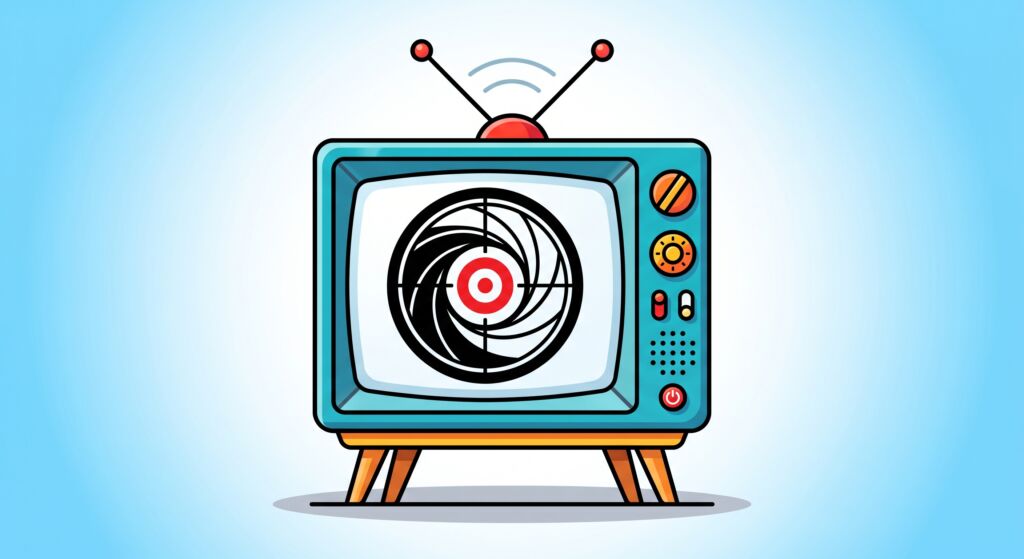
Shirley Marschall found herself in a hotel room with only local, linear TV to keep her company. Of course, it got her thinking about the state of modern media…
Time spent, by accident, in the media conditions that used to be permanent: no algorithms, no AI, no choice architecture, and no CTV. There was no home screen or app and nothing to scroll while deciding, because deciding wasn't a step. Whatever arrived, arrived. And it produced two things the industry's own research says are disappearing: discovery you didn't select and exposure other people shared with you.
It felt like falling through a hole in the calendar and landing somewhere that used to be permanent. Hotel rooms with linear, local, cable TV, and nothing else. Not even an option to plug in my Apple TV (which I had dragged along to avoid exactly that situation).
The TV found whatever it found: Italian game shows, in Italian, a language I don't speak; a French cooking programme, in French, a language I learned once but forgot entirely; and, one night, Casino Royale, a 20-year-old James Bond movie that everybody in the room had forgotten existed, Bond included. Nobody chose any of it. It just showed up.
This should have been irritating, and for the first few days it really was. I missed streaming… mildly and briefly. By day four, I’d watched more documentaries than I had in a decade, occasionally annoyed but mostly delighted.
And I wasn't watching alone. The hotel room had one TV, forcing everyone in the room in front of it. None of us had picked what was on, and all of us were now watching the same programme together. Apparently, that barely happens anymore.
The IPA's Making Sense report has an interesting line from Reach's Monica Majumdar: the decline of serendipity. The idea is that we used to stumble onto things via radio, TV, and magazines, whereas discovery now runs increasingly through curated feeds.
Lumen's Mike Follett has the number for the shared-viewing part. Ten years ago, two people of different ages had a 44% chance of consuming the same media at the same moment. Today, that overlap is 22%. His theory is that watching something together sends two signals at once, one from the advertiser and one from whoever's next to you, and solitary viewing mutes the second one entirely.
Which is where the (hi)story gets slightly complicated.
The TV industry spent years building infrastructure to provide unlimited choice and personalisation, and to eliminate the "I don't know what I want to watch" problem. Now that the infrastructure works, it discovered that the gap between turning on the TV and choosing what to watch is actually quite valuable.
Roku's redesigned home screen, launched this year, is a good example. Roku describes the new experience as a way to make discovery easier in a world where essentially everything is available to stream. And while at it, it also puts its Marquee Ad immediately in view when people turn on the TV, before they have chosen what to watch. Amazon has moved in a similar direction with Fire TV's discovery hub and ads. Both looked at the most valuable piece of unclaimed real estate left in the living room and found it was the not-yet-decided.
But all that choice hasn’t solved the discovery problem.
Nielsen’s Gracenote research puts some numbers around it. Its 2025 research found 45% of streaming users say the experience is overwhelming, with nearly half saying difficulty finding something to watch could be enough to make them cancel a service.
And now GenAI is being brought in to fix it. If there are too many services, too many titles and too many recommendations, why not simply ask a machine what to watch? Gracenote's April 2026 survey of US viewers found AI chatbots are becoming exactly that, a fast-growing way to navigate the fragmented TV landscape, but that 75% of people still fact-check what the chatbot tells them. Fair enough, especially considering a separate Gracenote study that tested AI across 2,600 movie and TV titles in 13 countries and found it had invented every piece of metadata, cast, genre, release year, the lot, for nearly one in five of them.
All of which is an increasingly elaborate way of dealing with something linear television solved by simply not asking.
But there is no pretending a month of pure cable TV is the media strategy of choice. I like choosing what I watch, and I was back on the CTV apps within days. However, there was something almost useful, professionally as much as personally, about a "dumb" TV that had no idea what I wanted to watch.
Strip the infrastructure out entirely and discovery randomly produces an old Bond movie. Put the infrastructure back in and the same moment is now inventory.
Which leaves one last question sitting underneath the targeting stack: if effectiveness research already says broad and shared beats narrow and solitary, and the platforms’ own data shows that personalised discovery hasn’t exactly eliminated the problem, what exactly is the precision buying beyond a way of reaching one person at a time who still can’t decide what to watch?







Follow ExchangeWire