
Agentic AI and the Evolution of Ad Sales
by on 6th Jul 2026 in News
Julian Ahrends, ADvendio's CTO, takes a look at how agentic AI is impacting the ad tech ecosystem...
For years, AI adoption in the advertising industry has been picking up pace. However, the complexity of the ecosystem has put true automation out of reach for far too long.
While digital platforms and ad tech solutions have long formed the bedrock of the industry, each platform has traditionally worked in a silo, adding more and more layers of administration to each solution, increasing its intricacy.
Although AI agents are present today in ad sales, their primary use has remained limited to individual tasks. In many ways, this current status quo has been the worst of both worlds. What has remained is that behind every digital campaign is a maze of disconnected systems and operational bottlenecks that still rely heavily on human coordination.

This isn’t about removing people from the process. It’s about removing the friction. And, it brings the industry back to a simple question of what actually drives performance.
To move forward, the industry has to solve the issue that has defined ad operations for decades: fragmentation.
The launch of Ad Context Protocol (AdCP) in 2025 was a major leap forward in solving the fragmentation challenge.
Below is a closer look at what agencies and executives need to know about AdCP to move beyond incremental gains and benefit from more autonomous AI tools.
The evolution of ad sales
To begin, it’s important to recognise the three distinct eras of ad sales. This started with a manual sales belt plagued with bottlenecks.
The rise of ad tech was built around sales professionals serving as the operational engine that kept campaigns moving. Every request had to be manually passed between clients and internal teams.
As such, the burden on operators was material. Campaign execution was slowed by email chains and, importantly, manual approvals. While the pace of work was a major issue, this meant the risk of missing a task or making a mistake was much more commonplace due to the sheer volume of tasks.
The ongoing rise of ad tech tools also meant that operational complexity increased faster than most organisations could scale headcount.
The rise of AI saw ad sales enter its second era of evolution, defined by AI-enabled assistance.
Initially, the AI copilots looked to be the ideal solution to the manual workflows that defined ad sales for years. There was also the rise of the co-pilot model, where sales teams began using GenAI to handle specific tasks.
While these tools improved productivity to a point, they did not solve the core structural problem of fragmentation. This meant that the technology was still hugely reliant on the sales team to move workflows forward with manual approvals and pass AI-completed tasks between software platforms
The launch of AdCP marked the start of the third era for ad sales, which is defined by autonomous, agentic automation..
Enter the agentic era of ad sales
As we reach mid-year in 2026, it’s clear that the future of ad sales will not simply be AI-enabled assistance. Rather, it will be fully agentic.
At the centre of this transformation is AdCP, an open standard that can run over transports such as Anthropic's MCP or Google's A2A. AdCP creates a shared language that allows AI systems across the advertising ecosystem to communicate directly with one another.
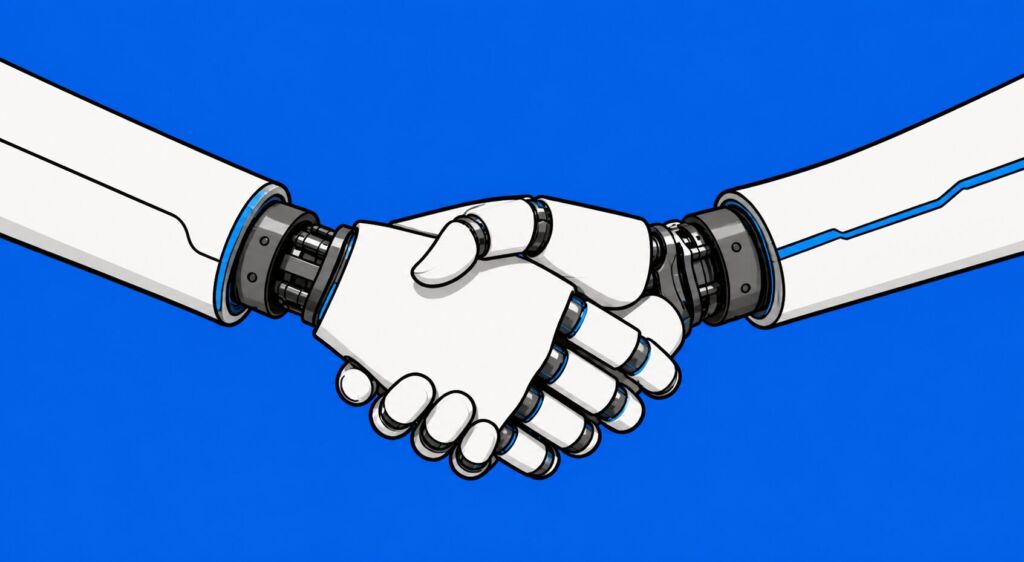
In practical terms, it acts as a universal translator for advertising operations, enabling autonomous agent-to-agent collaboration between buyers, publishers, media networks and ad tech platforms.
This shift represents something far larger than workflow automation.
It fundamentally changes how media businesses scale operations, generate revenue, and structure the role of teams inside the sales process.
Making AI-to-AI communication possible with a shared language
A common protocol lets agents talk. It does not, on its own, make the resulting transaction trustworthy, and in advertising, the transaction is everything. A buyer’s agent and a publisher’s agent can agree on inventory in seconds, but someone still has to recognise which agency this is under its annual framework agreement, apply the negotiated pricing rather than list price, count the spend toward that agency’s volume commitment, validate the deal against the publisher’s own margin floor, and reconcile it back to the system of record where the contract actually lives.
This is the part of the chain that has to sit on both sides of the deal at once, and it has to live where the commercial truth already lives: in the publisher’s and agency’s own systems of record, where the contracts, the relationships, and the financial terms are managed. An agent can route around a directory. It cannot route around the layer that decides whether a deal is allowed, correctly priced, and properly reconciled.
ADvendio’s position is exactly this layer: the commercial gateway that agent-to-agent transactions pass through. We champion AdCP as the open standard the industry should converge on, but the layer that enforces the commercial rules is reachable by any agent framework, whether built on Claude, Gemini, GPT, or a custom enterprise stack. The protocol stays open. The guardrails are what make the autonomous transaction safe to trust.
In an AdCP-powered environment, AI agents no longer operate in isolation. Instead, they communicate directly using a shared operational language.
For instance, a buyer’s AI agent can engage directly with a publisher’s or broadcaster’s AI agent to discover inventory, align targeting, verify availability, and negotiate terms in real time.
This is a major departure from traditional automation, which follows specific workflows. Agentic AI systems operate with greater contextual understanding and autonomy. They can adapt dynamically to changing objectives, and coordinate across multiple systems simultaneously.
For media organisations, Agentic AI creates the foundation for true operational scalability.
AI-to-AI collaboration
By enabling machine-to-machine collaboration through shared standards like AdCP, media businesses can automate much of the operational dialogue that previously consumed internal resources.
How agents communicate is a breakthrough, and how their transactions are validated is revolutionary. Cross-platform reconciliation is actively engineered by the commercial layer, not just a side-effect of the agents talking.
By sitting above the protocol, this layer securely executes the complex matching, clearing, and discrepancy resolution required to finalise a deal. Manual data re-entry disappears, and campaign activation timelines shrink.
Agentic AI is most powerful when it removes operational friction while preserving human judgment where it matters most.
This is why open standards like AdCP are so critical to the future of the industry and why the commercial layer that enforces trust around them, reachable by any agent, whether built on Claude, Gemini, GPT, or a custom stack, matters as much as the protocol itself.

ADvendio
Agentic AIFragmentationPerformance








Follow ExchangeWire