
Analysing The State of Web Push Advertising
by on 23rd Jul 2026 in News

Pierre Bertin, Head of International Business Development at Roller Ads looks at the changing face of web push advertising...
Web push advertising these days is far from stable. Some days, media buyers experience immense growth in clicks, impressions, and budgets accordingly. Other days, however, new policies drop and unsubscribe rates climb, and suddenly the future of the format seems less bright than it was.
But despite policy changes and market fluctuations, this ad format remains strong. The global push notification services market (which covers all channels, not just web push) is on a steady upward march. We’re talking USD$902m (£674m) in 2025, climbing to USD$1.36bn (£9.7m) by 2035.
But don’t let those big numbers fool you. Web push still has to overcome much stricter platform restrictions. The question many marketers are asking right now is whether web push is losing its edge or whether this is just another cycle of refinement. Well, let’s figure that out exactly.
Web push back in 2024-2025
Those of you who were running web push in late 2024 probably remember when things went awry with Google cracking down on this ad format. Specifically, Google made the unsubscribe button prominent and easy to access, upgrading its safe Browsing policies. It took just a night for a profitable and stable business practice to turn into the wild west.
Why Google hit the brakes
Push notifications had become an easy target for low-quality sources that were annoying at best and misleading and fraudulent at worst. Needless to say, users often felt frustrated and even resentful, to the point that both ad formats and the ecosystem’s reputations were taking a beating. Hence, Google’s response wasn’t subtle. The changes were designed to:
- Put control back in users’ hands with clearer, more visible opt-outs.
- Kill off abusive and misleading notification tactics.
- Raise the bar for engagement quality across the board.
The fallout that followed
The effects hit hard and fast. Once it became easy to unsubscribe, people used this opportunity. On the RollerAds platform alone, unsubscribe rates soared, at times by 30–40%, in a matter of weeks. Publishers who’d coasted on shaky opt-in practices watched subscriber counts dip, and revenue tighten.
And then the massive ban wave happened. Domains with compliance and quality issues were suspended in a blink. Some affiliates worked hard to save what had a chance and adapt; others, on the other hand, simply gave up.
Let’s get one thing straight: this is not a familiar market-saturation-type situation; this is a major structural shift. And with this shift, challenges that are awaiting in 2026, those who stay to fight, demand a completely new way of working with the format altogether.
That said, the channel is not dead, just evolving. And to prove the point, we turned to the Statista global forecast to look at and analyze the numbers and determine once and for all if the format is worth working with in 2026.
Data-based forecast for the web push ad industry
Policy shifts and platform crackdowns might have you side-eyeing web push hard in 2026. Fair. But if you look at the actual spend data, the story isn't "dying channel", it's a market growing up, not just blowing up.
Here's what the global forecast tells us:
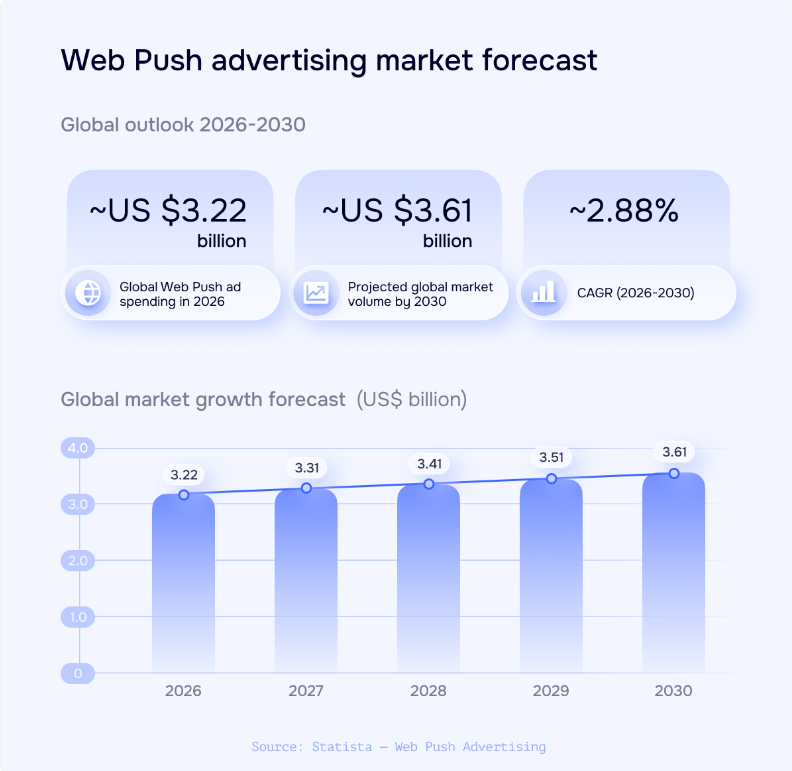
- Web push ad spending in 2026 is estimated at approximately USD$3.22bn (£2.4bn).
- By 2030, that number rises to about USD$3.61bn (£2.69bn).
- That equates to a CAGR of around 2.88% in the span of 2026–2030.
2.88% plus growth a year in an industry that’s supposedly on life support? Not really, if you ask us. It's a channel settling into a mature, sustainable rhythm. The gold rush days might be behind us, but for affiliates who adapt, there is still a seat at the table. Based on this rate, the market is expected to expand at a steady pace over the years:
- 2026: ~USD$3.22bn (£2.4bn)
- 2027: ~USD$3.31bn (£2.4bn)
- 2028: ~USD$3.41bn (£2.5bn)
- 2029: ~USD$3.51 billion (£2.6bn)
- 2030: ~USD$3.61bn (£2.69bn)
Via: RollerAds blog
So the market is still moving, just not as rapidly and unpredictably as it used to be. A CAGR of around 2.88% shows that web push has entered a stable phase. The days of abnormal growth driven by pure performance hype are ending. What we have now is a channel developing gradually rather than explosively.
This isn’t just about push also. It’s a trend you can see across the larger digital ad landscape, with growth that’s more gradual than sudden. New policies, changing privacy rules, and stricter platform controls have altered guidelines and the speed of the channel growth. They’re creating obstacles, not a dead end. The way growth happens has changed, but the overall direction remains the same.
Regional forecast highlights
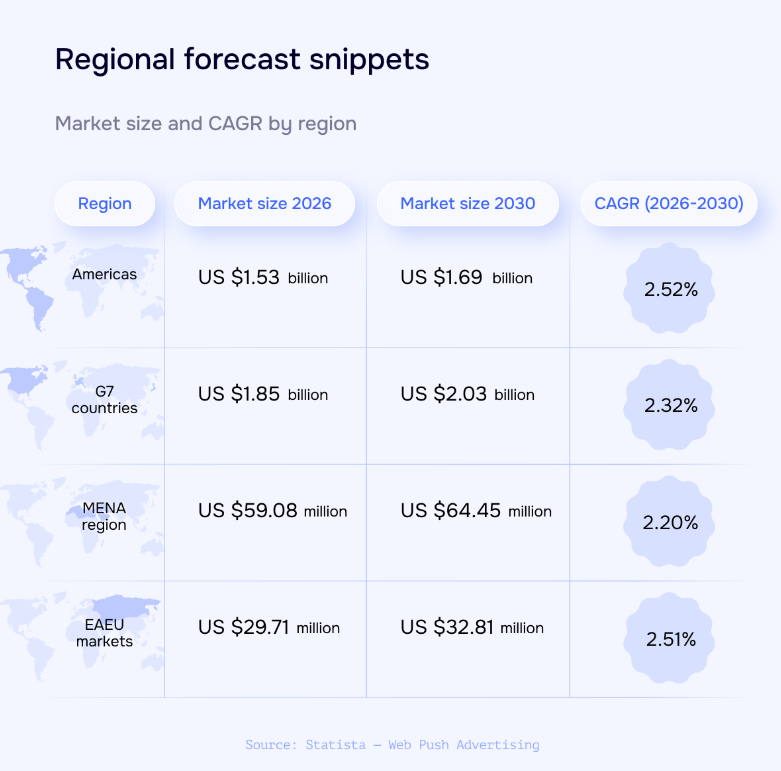
Statista’s regional forecasts show growth continuing through 2030, but at varying rates depending on each market's maturity.
~USD$1.53bn (£1.2bn) (2026) → ~USD$1.69bn (£1.3bn) (2030), CAGR ~2.52%
~USD$1.85bn (£1.4bn) (2026) → ~USD$2.03bn (£1.6bn) (2030), CAGR ~2.32%
~USD$59.08m (£44.1m) (2026) → ~USD$64.45m (£48.2m) (2030), CAGR ~2.20%
~USD$29.71m (£22.2m) (2026) → ~USD$32.81m (£24.5m) (2030), CAGR ~2.51%
Via: RollerAds blog
What the regional map shows us is that the rates aren't drastically different. G7 and MENA are increasing slowly, typical of mature markets behaving like mature markets. The Americas and EAEU are growing a bit faster, but in general, nobody is making any dramatic moves. Essentially, the only difference boils down to how deeply digital ads have initially sunk in.
The takeaway
Judging by the data above, there is a period of steady growth for web push advertising. Major platforms adjust their rules to filter out bad and spammy advertising practices. Which is good if you work with reputable ad networks like RollerAds that focus on increasing the LTV of each user.
Yes, you might experience some short-term performance dips, but this is just a part of the journey. They are just growing pains as the channel moves toward higher-quality standards and, eventually, better click-through rates. When the flood of low-grade notifications recedes, that relief shows up as better engagement within a year or so. User pressure drops as they no longer feel overwhelmed and frustrated.
For most of the last couple of years, the market held together on a kind of messy scale. As soon as someone bowed out, a fresh face jumped in to grab their spot. You could call it dynamic stability, chaotic, yet somehow balanced. Then enforcement actually intensified, and that shaky equilibrium broke apart. Now the low-quality sources are getting tossed aside, and the compliant, performance-obsessed players are the ones who get their much-deserved attention.
The knock-on effects aren’t the same everywhere. Where supply dried up a bit, CPMs nudged higher in the short term. Where the competition backed off, the serious marketers actually saw greater efficiency and more results for the same spend. That’s not a crisis. It’s the market catching its breath after a jolt, the sort of reset that leaves the whole channel healthier once the noise clears out.
Over time, that cleanup should help the format’s reputation clear and attract stronger demand from Tier 1 and Tier 2 advertisers. In the meantime, expect things to wobble: volumes will jump around, performance will have its ups and downs. But we’re still looking at moderate growth, just with much cleaner lines this time.
Where web push is heading next
The industry is shifting gears from pure volume to performance and ROI. That demands everyone to adapt:
- Old-school spray-and-pray tactics are not performing that well.
- New optimisation frameworks keep cropping up.
- Traffic sources are building tech to meet stricter regs head-on.
- Advertisers are changing funnels, honing targeting, and switching attention from short-term ROI to lifetime value.
Web push is evolving from scale-at-all-costs to a results-driven, structured environment that rewards quality over quantity. A bit of swing in some verticals is to be expected, but the overall trend is steady, gradual growth.
For advertisers, publishers, and networks, the math is changing; high performance won't be measured in raw volume anymore. It'll come down to relevance and engagement quality.
AdvertisingCross-ChannelWebsite






Follow ExchangeWire