
Cannes, Rosé and The Sand Theory of AI Adoption
by Shirley Marschall on 17th Jun 2026 in News
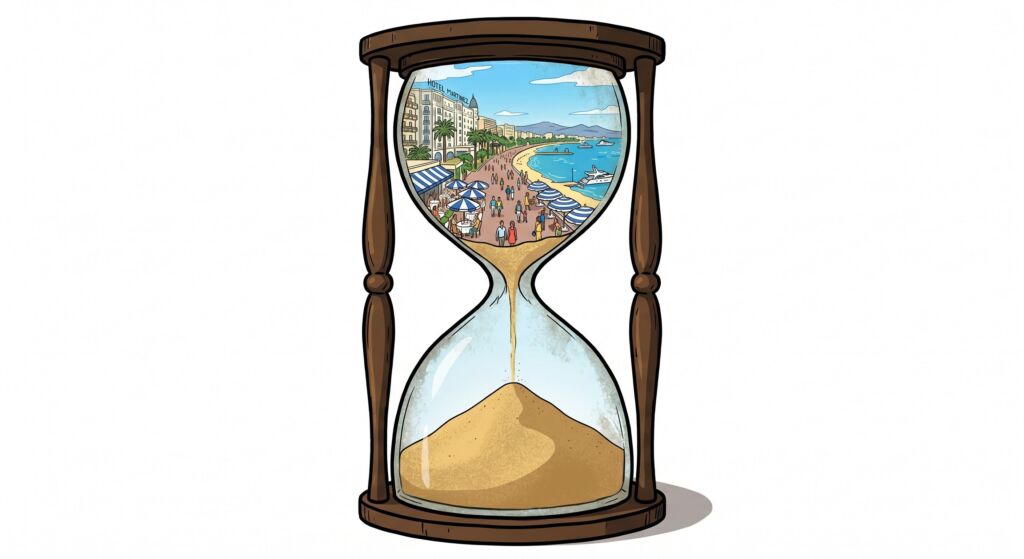
With Cannes almost upon us, Shirley Marschall takes a look at sand, AI hype, and how novelty becomes consensus...
Cannes Lions, it's almost that time of year again. The heat on La Croisette. Rosé in hand. The Mediterranean in the background. Great conversations with the best brands, creative minds, and people who move the industry forward...
And then there's sand.
Spend a day at the beach, just one, and the sand comes with you. It's in your shoes before you've reached the car. It's in your bag, your hair, the folds of your towel, your toes. A week later you'll find it in the pocket of trousers you didn't even wear. Two weeks on, it reappears in your bathroom. Then your suitcase lining. Then, somehow, in a bag that never even went to Cannes.
You didn't decide to take the sand home. You certainly didn't build a strategy for introducing sand. You just went to the beach, and the sand came along.
This is roughly how AI arrived in… everything.
Shopping agents, AI toothbrushes, email AI-clippy tools, customer support bots, note taking assistance. Products that spent decades working perfectly fine without AI suddenly acquired it, because every brand and product decided they couldn’t possibly afford not to have it. And no, nobody woke up asking for an AI toothbrush, yet here we are.
What shifted this year is the mood. The early cycle ran on novelty (and plenty of opportunism). This one runs on AI no longer being theoretical. It's already embedded in everyone's daily life, unreliable in small but annoyingly persistent ways. It summarises the wrong thing, contradicts itself, overconfidently fills gaps that were never there. There is even a name floating around for this experience, AI Rage Syndrome, which tells you something about where we are.
But the frustration isn't necessarily with the idea of AI itself. It's with this specific, uninvited version that showed up and is now everywhere.
In ad tech, AI and agentic is already inside targeting, bidding, creative optimisation, measurement… yes, everything. Sometimes visible, sometimes not. Definitely vocal though and Cannes conversations this year will be full of it, in both senses. AI partnerships. AI platforms. AI frameworks. AI as the frame through which every announcement is passed. In combination with agentic, obviously, because AI as a standalone is so 2025.
Which is all fine, except the conversations often assume adoption is still a decision being made or a roadmap to be drawn. In most cases though, that decision was already made. Not through a board decision or a procurement process that selected the winning system. It arrived as a feature, an update, a new capability.
All of this will soon get discussed, at some length, over several glasses of rosé. Which is not a criticism, the rosé is excellent and the setting couldn’t be better, but there is something particular about the way consensus forms at events such as Cannes. The conviction and the ambient enthusiasm become harder to tell apart.
By the third conversation of the late afternoon, the line between what someone believes and what the terrace has agreed to believe has moved somewhere. Announcements describing "advertising platforms built for the agentic age" joining forces with "platforms for the outcomes era" to deliver "industry-first implementations of an agentic framework" understandably blur into one another. Three eras, a lot to take in and clearly somewhere between the thing and the description of the thing, the heat got to it.
And ad tech does what ad tech does best and defaults to treating presence as proof. A capability gets embedded, it starts appearing in pitch decks, and somewhere in the translation, being in the stack becomes evidence of working. Adoption statistics get cited as performance statistics. The sand that’s now everywhere gets reported as: the sand is good.
Some of it is good. Some of it measurably so. But presence and quality are different things, and conflating them is how you end up with an industry-wide conversation about AI that doesn't quite match what people are experiencing when they actually try to use it. Ironically, the hallucination here is a human one.
Anyway, LinkedIn is flooded with "see you in Cannes” and what would be really interesting is not how many of these announcements were written by AI, but how many of those attending let their AI agents book the trip. Fully autonomous. Because there is something slightly surreal about the way the industry talks about a future of automation while continuing to gather in person to discuss it. If AI agents are about to handle scheduling, negotiation, and communication on our behalf, the Croisette should be noticeably quieter by now, no?
Well, looks like the industry has made its own judgement and that mileagemaxxing still beats tokenmaxxing despite everything. Because even as AI spreads into the systems, the platforms, the workflows, and increasingly the language, Cannes remains stubbornly, pleasurably itself.
The rosé is cold and the Cote D'azur is beautiful and seriously, who would want to automate that?
Ad SpendAd TechAgentic AIAIArtificial IntelligenceCannes



Follow ExchangeWire