
On Signals, Cutting Twice, and What People (Really) Want
by Shirley Marschall on 15th Jul 2026 in News

Shirley Marschall is back, and this week she's looking at why some of the clearest signals are consumers saying exactly what they don’t want...
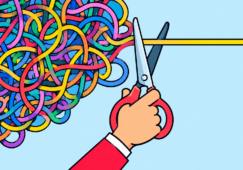
There's a German line tailors use, half joke and half warning: zweimal abgeschnitten und immer noch zu kurz. Cut twice and it’s still too short. The first cut was wrong, the second cut was meant to fix it. Yet the fabric is shorter than when you started and every correction just moves the mistake further along.
That's what's happening to signals too. Ad tech takes a bunch of signals (dwell time, scroll depth, purchase history, attention, agent logs, intent and whatnot), re-cuts and stitches them into ever newer shapes believing, or perhaps just hoping, the reshuffle will eventually start looking convincing. Except these signals tell you what happened. They rarely tell you what the person wanted to happen.
There are alternative and arguably stronger signals though, sitting right there, in plain sight… just not where the industry usually looks. Meanwhile the industry spends billions trying to decode customers while overlooking the moments when people simply spell it out themselves.
What follows only gets louder from here.
How-to pages
How-to pages: what a wonderful source of user sentiment and signal. Take Samsung’s support article, titled How to Turn Off Ads on a Family Hub Smart Fridge. Or last week's countless guides on how to stop Meta's AI image generator from using your Instagram photos, after Meta started letting strangers generate images from someone else's photos without even bothering notifying that person it had happened.
Of course there are plenty more how-to’s where these came from. How to opt out of Google’s expanded AI training data, which now includes images, files, and voice recordings, folded neatly into a privacy settings update. Or OpenAI’s data controls FAQ walking users through exactly how to stop their conversations from training the model. Four different companies, four different products, (yes, mostly the theme du jour is AI) all with the same user request: stop using what I gave you to build the thing I didn't ask for.
And rest assured, nobody searches how to turn something off unless they've already decided that they don't want it. This isn't inferred from a click pattern. It's typed, in plain language, and that's a cleaner signal than anything ad tech could possibly harvest.
The Push-back
Enough individual refusals and opt-outs arriving at once, and it stops being individual.Meta's Muse Image tagging didn't even survive the week, before Meta admitted it had "missed the mark". Or HubSpot’s attempt to automatically enrol users into a data-pooling programme to feed an AI contact enrichment tool, before being reversed after widespread backlash: "We got this wrong. And we are fixing it."
No, it’s not always about AI. After a wave of criticism over surveillance concerns, triggered by a Super Bowl ad, Ring abandoned its planned integration with Flock Safety. Or Roku, which tested auto-play video ads before the home screen, prompting immediate user backlash. Roku said it was only a test. Fine… it was definitely testing users’ tolerance.
This is almost textbook evidence that customer pushback can change policies and that some of the clearest signals are consumers saying exactly what they don’t want. Some signals really don’t need modelling.
The Push-forward
And then there's the signal that isn't refusal at all, just people walking toward something else. When Google overhauled Search at its May developer conference, replacing links with an AI-first interface and no clean way to turn it off, DuckDuckGo's US app installs rose by an average of 18% week over week within days, peaking above 30% growth on the single busiest day. Traffic to its AI-free search page climbed alongside it. DuckDuckGo's own read was blunt: Google is "force-feeding AI with no way to opt out". A market signalling loud and clear while voting with its download button, in real time.
Though some aren't walking toward anything, they just never showed up. Google+ is the classic history book example of a technically sound product that still fell flat on its face because users simply refused to leave Facebook. Or OpenAI’s Sora app, launched with enormous attention around AI-generated video but after the initial curiosity spike… OpenAI shut it down less than two years after its unveiling.
Yes, sometimes the market’s loudest signal is silence.
The Sabotage
One step past all that is sabotage. A musician going by "Mr. Daniels" took his entire back catalogue, stripped the vocals, replaced every one of them with Homer Simpson, and reuploaded the lot under the original song titles so any model scraping it for training data would ingest the substitution without knowing. Funny, but it’s also not an isolated incident.
Sabotaging or poisoning AI training data has been a known vulnerability for a while, catalogued as one of the Top 10 risks for LLMs, and researchers at Anthropic and the UK AI Security Institute found that as few as 250 corrupted documents could reliably backdoor any language model.
What's new isn't the tactic but who's picked it up. Brands are now running the same play against each other, seeding forums, reviews, and comparison content to shape what an LLM says about a competitor, hoping the model repeats it back as settled fact. Same mechanism as Mr. Daniels, minus the joke: if the signal is going to get scraped regardless, feed it something false on purpose. Well aware that consumers mostly don't check. So the "signal" isn't necessarily a clean read of what someone wants, as someone else might have salted it to begin with.
Shay Brog, CEO of Burt Intelligence, wrapped up this entire topic brilliantly, borrowing from the social economist Albert O. Hirschman's Exit, Voice, and Loyalty. Hirschman described how across workplaces, political parties, schools, and consumer settings alike, dissatisfaction runs up against the same ultimatum, leave, or say something. Every signal above sorts into one of the two, mostly. Exit, voice, and whatever Mr. Daniels is.
Ad TechMeasurementSuper Signal Aggregator





Follow ExchangeWire