
World Cup Advertisers Sitting on Untapped Media Value - Parallel Study Finds
by on 15th Jul 2026 in News
The biggest advertising moment of the year is also one of the biggest opportunities to make media work harder. A new study from the Digital Twin activation platform Parallel finds that World Cup advertisers could lift the resonance of their placements by almost 50% by optimising how strongly an ad lands with the customer watching it, rather than to contextual category alone.
That's the key finding of the first Customer Suitability Report from Parallel, the UK-Australian start-up whose human-calibrated digital twins score resonance - the fit between a customer, an ad, and the content they're viewing - and turn those scores into media activation.
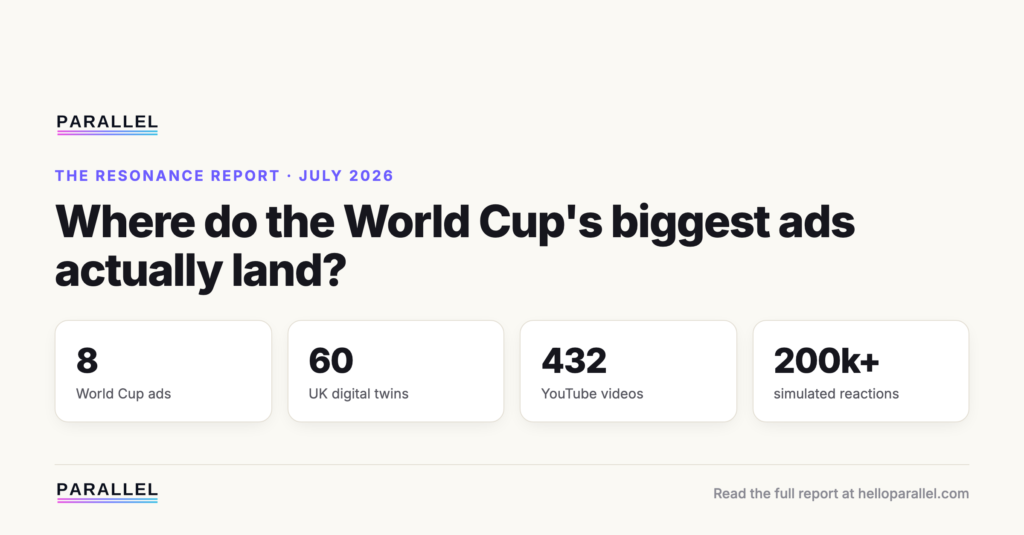
Parallel tested eight publicly available World Cup ads from major brands, Walkers, McDonald's, Betfair, Stella Artois, Nike, Burberry, Pepsi, and Coca-Cola, against 432 YouTube videos, using a UK panel of 60 human-calibrated digital twins and generating more than 200,000 simulated responses. The results were benchmarked against eight non-World Cup UK ads tested on the identical panel and videos.
Three findings stand out:
- Even the biggest ads have a small sweet spot. On average, the World Cup ads resonated highly with the content in only about 1 video in 10. The ad with the broadest fit, from Walkers, reached roughly 1 in 8.
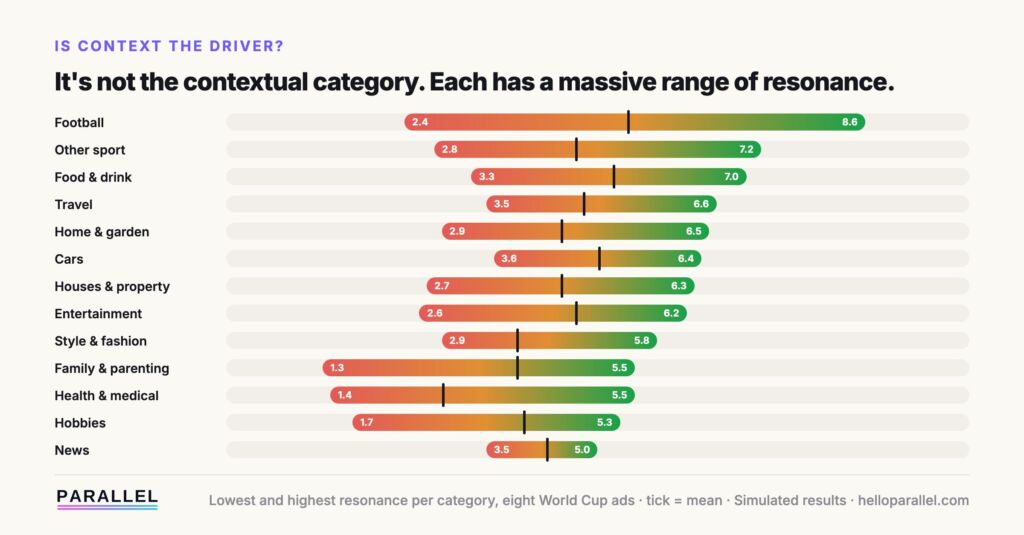
- Contextual category is a poor predictor of where an ad lands. Every category contained a wide spread of resonance. Within football content alone (the most obvious place to put these World Cup based ads), the same Walkers ad scored from 3.8/10 to 8.4/10 in range across various content.
- Optimising to resonance beats every category buy. Buying football contexts did work - it lifted average resonance by around 13% compared with buying across all content. However, optimising placements to resonance instead would have driven a lift of almost 50% - roughly a third more than a football-only buy achieves.
The study traces the differences to the viewer's need-state, the underlying reason someone is watching a piece of content. The World Cup ads out-performed the non-World Cup benchmark in the two "fun" need-states, reward and treat, and escape and entertainment, and ran cooler in the other seven. The implication for advertisers is to buy the moments their creative was made for, rather than a broad contextual category.
The study also offers a first read on the value of the tournament's most familiar face: ads fronted by David Beckham (four of the eight tested) found high resonating content to serve in around 40% more often than the four without him.
Every ad impression is already checked twice before it is bought, for brand safety and for brand suitability. Parallel's platform adds the missing third check, which it calls customer suitability: is this creative and content combination right for the customer?
"Delivering ads into places they don’t resonate with the customer can be wasted spend. But when you get it right it beats everything," said Parallel CEO Rob Hall. "We’re finding more and more that the signal that drives advertising resonance isn’t semantic alignment of your ad into a given context, it’s: which customer need states suit your ad? That's what customer suitability aims to deliver on."
"By running Digital Twin simulations, brands can see the type of content their ad will perform best against and place their campaigns accordingly," Hall continued. "For the first time, advertisers can optimise to a resonance goal instead of chasing contextual alignment. The same budget simply lands better."
To view the full report, visit https://helloparallel.com/reports/resonance-july-2026/.
Methodology
Parallel analysed eight UK World Cup-season ads in July 2026 using a panel of 60 human-calibrated UK digital twins aged 18+. Each ad was scored for resonance against 432 public YouTube videos (162 football and sport, 270 non-football), generating more than 200,000 simulated responses. Results were compared with eight non-World Cup UK ads tested against the same panel and content. Resonance is scored 0-10 for every combination of customer, ad and video; scores of 7 and above are classed as high resonance. Findings are based on simulated responses rather than live campaign performance.

Parallel
Brand SuitabilityOptimisationResearchSports







Follow ExchangeWire