
The Ad Tech Toll Road
by Shirley Marschall on 16th Sep 2026 in News
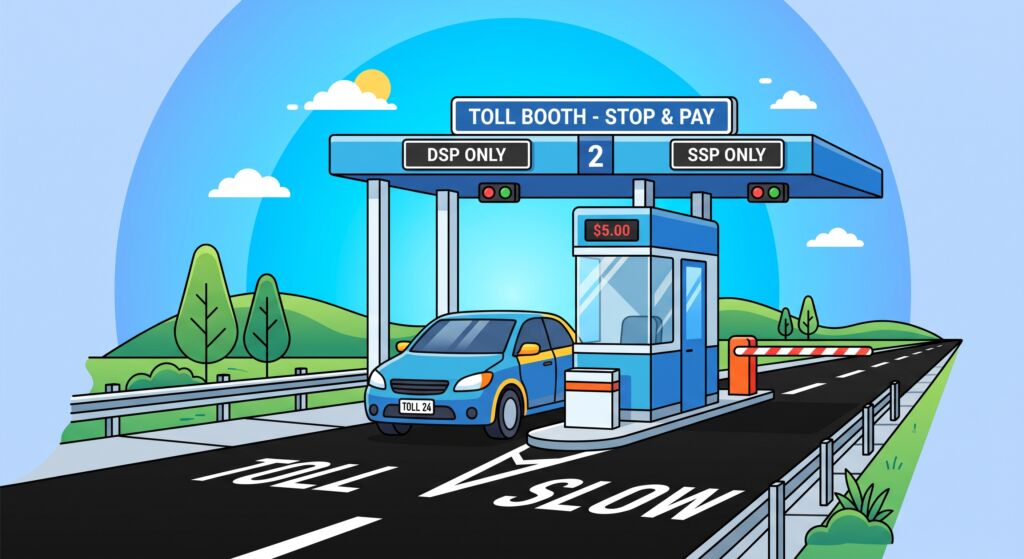
Shirley Marschall took a road trip around Europe, and the experience got her thinking about ad tech tolls...
A road trip through Europe and ad tech's oldest question: how much of my ad spend actually pays for the media, and how much pays for the journey to get there?
Germany's autobahn is free but its petrol is eye-wateringly expensive. Spain's fuel is cheap(er) and its roads split, unpredictably, into stretches you pay for and stretches you don't. France charges heavily for both highway and gas, and still can't tell you in advance what a trip will cost, because some stretches charge by distance, others by a flat toll. Austria sells a vignette, one sticker, one price, covering the whole road network for a period, on top of its super high fuel prices. Neighbours sometimes align, Germany and the Netherlands both wave cars through toll-free, and sometimes don’t. Some countries charge for using the service station restroom. Others don’t.
In the end you have no idea what a road trip costs unless you're into totalling receipts back home. And even then, what's the real price per kilometre once you account for the toll, the fuel, and all those additional little fees?
Ad tech’s supply chain runs on a very similar highway system, just with another kind of traffic. And so a road-trip economics question translates to many of ad tech’s oldest questions: How much tech stack sits between an advertiser and a publisher? What percentage of the media spend actually reaches the publisher? When the same impression travels through multiple paths, are we paying different tolls for essentially the same road?
An advertiser starts with a media budget and, ideally, ends with an impression delivered to a consumer. In between, it travels through DSPs, SSPs, verification vendors, data and identity providers, and whatever bits of other infrastructure have accumulated around the transaction along the way. Each comes with a price tag. But knowing that a fee exists isn't the same as understanding the economics of the entire journey.
To add to the complexity, not all fees are equal, either. There are tech fees, data fees, platform fees, transaction fees, verification fees. Some show up on the invoice. Others are simply embedded in the transaction… the way a marked-up petrol price hides a toll that isn’t charged directly.
And then there are different currencies. A CPM here, a percentage of media spend there, a flat fee somewhere else. None of which convert cleanly into one another. A percentage fee moves with the price of the media it's taken from. A flat fee doesn't move at all.
Plenty of studies and audits agree. The ANA’s 2024 Programmatic Transparency Benchmark found that only 43.9% of USD$1 (£.74)entering a DSP ultimately reaches the consumer, after 29.8% goes to transaction costs and another 26.3% is lost to media productivity. The ANA has kept measuring since, turning the one-off study into a running quarterly benchmark, with working media reaching 45.1% in Q2 2026.. ISBA and PwC's UK audits told the same story from a different angle: 15% of spend unaccounted for in 2020, still an unresolved 3% by 2022 even after two years of industry effort to fix it. Independent research from Adalytics gets closer to the strangeness underneath the average: one SSP was found charging a single publisher anywhere from 7-42% on the same site, same buyer, same DSP, with no discernible pattern behind the swing, and in one recorded transaction a USD$10 (£7.42)bid returned the publisher 29 cents. Different studies, different methodologies, the same basic shape which isn't news to anyone in the ad tech business.
The ANA and ISBA numbers answer "how much did you lose." SPO, curation, direct deals, they're the industry's answer to "how to lose less," and they work the way local knowledge of a toll road works: you learn which stretches to avoid, which SSPs double-dip, which exchanges to route around. You’re essentially getting better at reading the toll road maps, not necessarily a simpler toll system.
Walled gardens solve a different problem. Not which road is cheapest, but how to stop having to choose at all. One bundled price removes the need for local knowledge, which is exactly the value proposition. Complexity-avoidance-as-a-product; spend years learning, or pay one number to one company and never look at a tollbooth again…
And then there's a third option. Frans Riemersma, Martech Tribe founder, analysed nearly a thousand real-world marketing stacks against revenue per employee and found that the top-performing companies consistently run fewer programmatic capabilities and less mature programmatic stacks than their weaker-performing peers. So if SPO and curation are locals getting really good at finding the cheapest route through the existing toll network, and walled gardens are locals who just moved next to the highway, the actual out-performers in the data are doing something different from both: Fewer trips.
But just like a toll highway isn’t inherently a bad thing just because someone charges for using it, neither is the ad tech ecosystem. After all, a toll road is perfectly reasonable if it gets you somewhere faster, safely and reliably. Just as long as you know what you’re paying for.





Follow ExchangeWire