
The Problem With Seedless Watermelons and Ad Tech
by Shirley Marschall on 3rd Jun 2026 in News
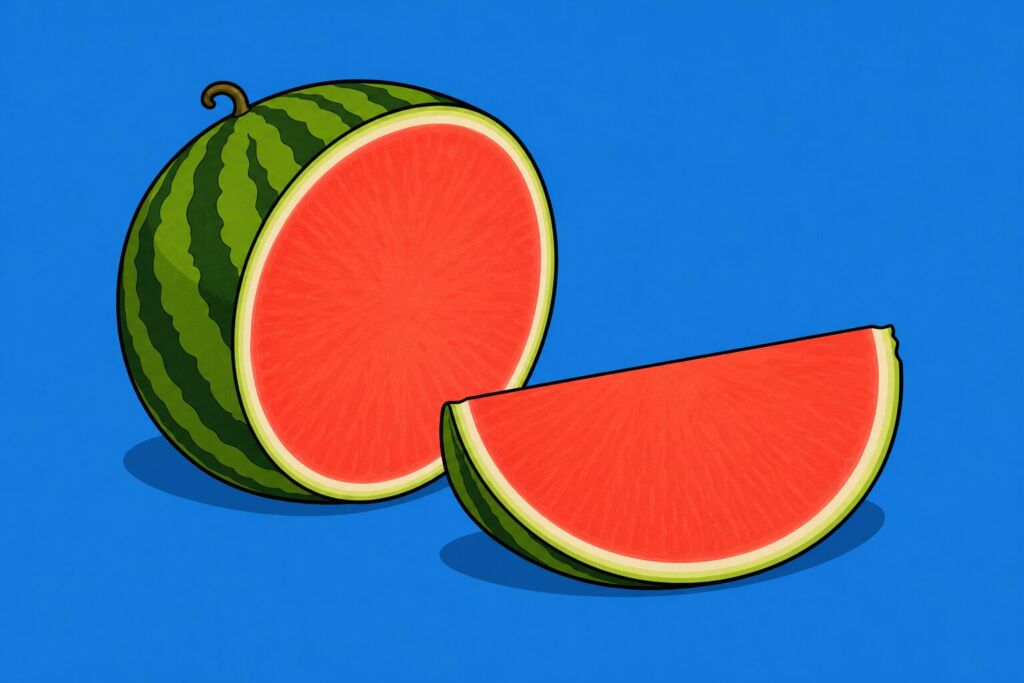
What links a disappointingly dull watermelon and the ad tech ecosystem? Only Shirley Marschall could bring you the answer...
Nothing tastes more like summer than a watermelon. At least, that's right up until the moment when you take the first bite of the season and remember that the taste nowadays vaguely resembles a cucumber. One that was painted red. Watermelon-shaped. Watermelon-coloured. Technically watermelon, but definitely missing the thing that made it worth eating in the first place.
Because somewhere along the way, as humans tend to do, watermelons changed. We ‘optimised' them. The big seeded ones, sticky fingers, black seeds everywhere, juice down your arm, disappeared and left a perfectly engineered seedless version behind. Easier to eat and sell and yet something got lost along the way: texture, sweetness, character, even the ritual of eating them.
Optimised, flattened, forgettable, frictionless, convenient. That maps surprisingly well to ad tech and digital media, doesn't it?
Friction is the enemy. Every extra click, every loading delay, every unpredictable moment in the customer journey is something to engineer away. The industry got especially good at this and the results are, of course, extraordinarily efficient. And no one has any intention whatsoever of stopping here, because optimisation rarely stops at good enough. It continues because it can, and what gets lost isn't functionality, it's character, texture, and the harder-to-measure qualities that made things distinct to begin with. Collateral damage.
Until everything is flattened toward the same equilibrium: the same formats, the same incentives, the same carefully measured outcomes. A sameness that is the logical output of the logic itself. The ecosystem rewards what scales smoothly: standardised formats, measurable performance, predictable engagement. The problem is that systems optimised around scale naturally drift toward… right, sameness. Incremental differences disappear first. Then distinctiveness itself starts eroding and eventually, something the numbers can't capture starts draining out.
The trouble with sameness is that humans acclimatise to it fast. Algorithms may optimise distribution, but the human mind still decides what feels memorable. And in saturated environments, people quickly learn to ignore anything that feels incrementally different rather than genuinely distinct.
Now AI enters the picture, not as a new problem, but as a force multiplier for the existing one. As Martin Delaney, Founder of PUNKworks, recently wrote: "Every piece of fruit goes into the blender, and the smoothie comes out tasting the same. Unless you feed it an original recipe."
Most won't. Original recipes are inconvenient. They require conviction, taste, and the willingness to produce something that doesn’t immediately resemble everything else. Whereas the AI blender is right there, fast, and the output is perfectly adequate.
Creative is one of those areas where this gets most visible. When the cost of production drops to near zero, the rational move is to produce more. More variants, more formats, more personalisation at scale. And for a while that works, or at least appears to in the dashboard. What it tends to produce in practice though is what Barney Worfolk Smith, CGO at DAIVID, called the branded sloppening: a feed flooded with content that is technically on-brand, technically targeted, technically optimised, and aggressively forgettable. Competent enough to pass through the system. Not distinctive enough to interrupt it.
Barney is also clear on where it ends up: "Initially, speed to market will trump creative quality. If the cost of production drastically reduces we'd be naïve to think brands both large and small won't harness it, fuelling the branded sloppening on our feeds. But as always, too much of a sugar high leads to a crash, where we need more substantive and interrogated creative which is actually meeting brand goals."
The sugar high implies a trajectory the efficiency discussion tends to conveniently skip over. Optimisation logic is static: inputs, outputs, performance metrics. Efficient, measurable, repeatable. It doesn't account for saturation, for the point at which an audience has seen so many competently assembled, frictionlessly delivered pieces of content that it stops registering any of them. At which point the optimisation has optimised itself into irrelevance.
Meanwhile, the AI backlash picking up speed is the market's response to exactly this, even if most people experiencing it can't articulate why. Alberto Romero's recent compilation of US poll data across Gallup, Pew, NBC, and others tells an interesting story: Gen Z uses AI at the same rate as before but likes it considerably less. Excitement down 14 points in a year; anger up 9. That's a very specific disillusionment that comes from repeated exposure to something hollow. The texture is gone and people feel it, in the feed, in the creative, in the brand voice that sounds like it was stress-tested into submission.
The consequences aren't just cultural. For ad tech vendors and platforms, a world where everything is a seedless watermelon is a world where the only remaining differentiator is operational efficiency and price. If creative tools all produce the same output, if targeting approaches all draw from the same modelled audiences, if measurement systems all report against the same proxy metrics, then the ecosystem has a problem that efficiency can't solve. Google, Amazon and Meta, who benefit structurally from standardisation, are fine with that. Most of the rest of the stack should not be.
Anyway, just give me my watermelon with seeds back…
Ad TechAIDigital MarketingMediaOptimisation





Follow ExchangeWire