
AI Can't Recommend a Sunscreen. How Could It Possibly Book a Trip?
by Shirley Marschall on 5th Aug 2026 in News
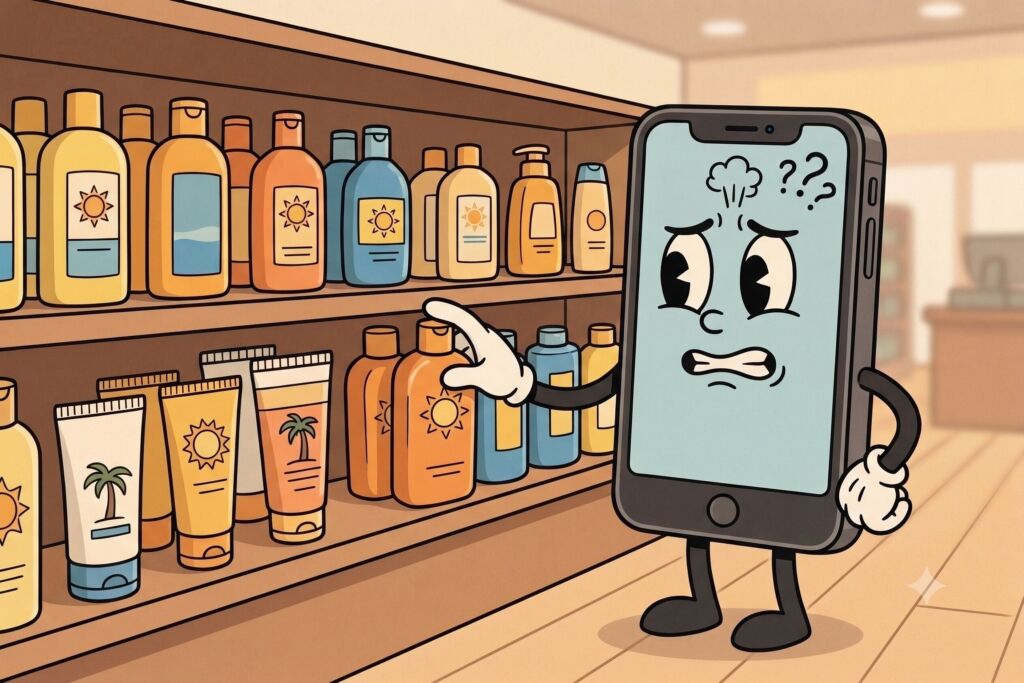
It’s summer holiday season, and Shirley Marschall is looking at AI and the paradox of choice…
Travel, accommodation, and sunscreen have nothing in common except one thing: too many options. Fifty near-identical villas. Forty sunscreens, all claiming to be the one. Psychologist Barry Schwartz named this decades ago as the paradox of choice: past a certain point, more options don't make us freer, they make us worse at deciding and more likely to regret whatever we end up picking. A new PHD and WARC report opens with a version of the same diagnosis, calling marketing an age of abundance, more content and choice than consumers have the attention or means to manage. Agents arrive as the proposed cure. Feed it your preferences, get a shortlist, be done. Schwartz's paradox, solved by software.
Except the best option rarely exists as a neat shortlist...
A rental home can tick every box: location, price, rating. Then one sentence in a review changes everything: "The neighbour's cat is cute."... For most travellers, a charming detail. For someone like me, travelling with a dog, a deal breaker. Another place has parking. Great, until a comment mentions the road leading to it is extremely narrow. A no-go with my suboptimal parking skills, making what looked like a plus a reason to keep searching.
Then the route itself stopped cooperating with the plan. Wildfires closed a stretch of highway mapped days earlier, and three hours of driving had to be rebuilt, around a fire an algorithm had no way of pricing in when it optimised the trip in the first place. While re-planning the route, I spotted an outlet mall. Suddenly, a two-hour detour became completely reasonable. An algorithm might log extra driving time, but I saw a much better vacation.
All of it was available information, but nobody and no algorithm knew it mattered until it appeared.
Human decision-making is inconvenient. We don’t start with a complete list of requirements. We discover what matters while searching, and sometimes the world changes the requirements for us.
The PHD and WARC report has travel and transport heading further into agent territory than almost any other category: agent-facilitated spending in the sector is projected to jump from USD$78.1bn (£58bn) this year to USD$275.6bn (£204.9bn) by 2030, placed in what the report calls the "agent-to-agent" quadrant, where AI on the brand side and AI on the consumer side increasingly transact directly. Audi's Dr. Oksana Koval, cited in the report, argues that adjectives won’t survive the handoff to a machine. A car isn't "roomy," it has a trunk size. It isn't "fast," it has a top speed.
Fair enough. But a two-hour detour for an outlet mall isn't an attribute either. Neither is a neighbour's pet, or a 'private' pool that turns out, three photos in, to be a kids pool. You can’t feed an agent structured data for things you don't know matter, or don't know exist. For AI to plan that trip successfully, it would have needed a version of me smart enough to know what I wanted before I did, which is a modest definition of AGI.
The same thing happened with something much simpler: sunscreen.
If there was ever a clean AI shopping task, this seemed like it. Ingredients are structured information, about as agent-readable as data gets. Sensitive skin is a clear requirement. This should have been the one case where the technology actually earns the hype and the abundance problem gets solved on contact.
Instead, asked to compare formulas, AI didn't parse a single ingredient list. It handed back the three most common sunscreens, in roughly the same language their own websites use. No niche products, let alone real comparison. Just a summary of whoever’s marketing was working hardest or whatever signals the model happened to be picking up. Hours and countless prompts later, I copied the INCI list from one of the AI’s own recommendations back into the model. This time it concluded the formula wasn’t actually a good fit for my skin. In the end, forty options became three, and the three weren't even chosen for me. I closed the tab and bought nothing.
It's a small, petty frustration, and also one the same PHD/WARC report ends up confirming: toiletries and cosmetics are filed under what it calls "consumer to consumer," where influence stays human and AI's role stays marginal. The advice to brands isn't to feed the machine better data but to protect the community and creator voices AI can't replace, and to "preserve the experiential aspects of beauty."
Two different categories, two different failures, and a couple of questions: How much time does it take to teach an agent enough about you before it actually saves you time? And if AI recommendations are already tripping, what’s the chance agentic shopping will ever take off?
At some point the consumer isn't delegating a decision but building a digital version of themselves first, one exception at a time, which is its own kind of abundance problem. The overload used to be out there, in the options. Now it's in here, in the effort of pre-loading your brain into a prompt.
And unlike the customer, AI doesn’t have allergies, a dog, or anxiety about making the wrong booking. It isn’t the one spending £300 on accommodation or £25 on sunscreen. It literally has no skin in the game.
Agentic AIAIConsumerPersonalisationRetailRetail Media








Follow ExchangeWire