
From Screen to Store: The Creative DOOH Choices that Drive Consumer Intent
by on 22nd Oct 2026 in News
Martine Hammink, VP, Creative Studio & Creative Solutions at Vistar Media looks at how DOOH is a home for creative and performance…

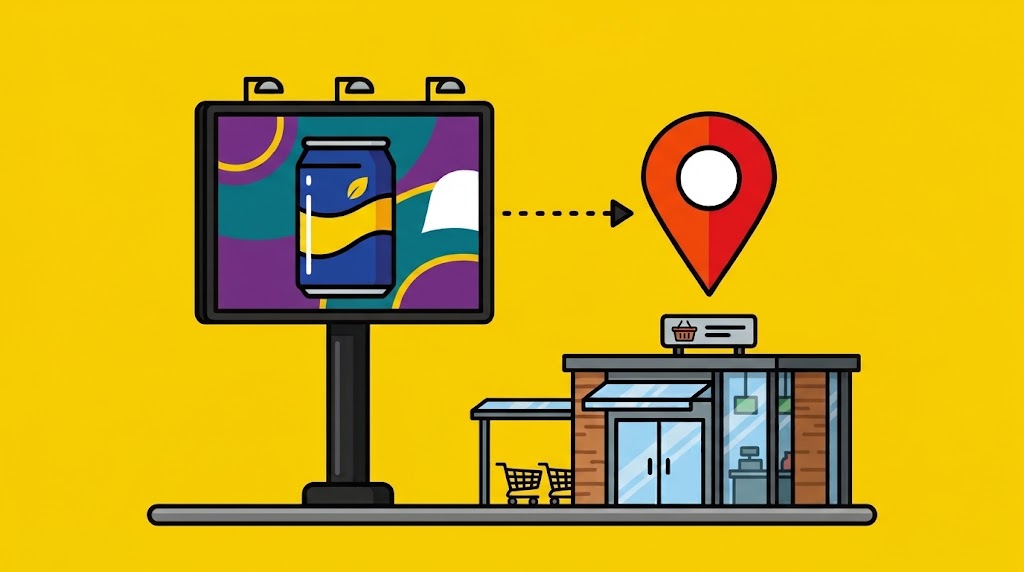
Every brand that sells in physical stores, from supermarkets and high street shops to cafés and car dealerships, faces the same challenge: closing the gap between interest and the point of sale. Consumers want the answer to one question: where can I buy it? Programmatic digital out-of-home (pDOOH) is well placed to answer it, because the screen is often only a few minutes' walk or drive from the shelf.
Activating pDOOH screens near points of sale, with dynamic creative automatically showing the nearest store, is now well understood as an effective tactic. It delivers hyperlocal relevance at scale, and measurement studies have already shown us that these campaigns drive real footfall and in-store sales. But we wanted to take that a step further and understand how much impact the store locator itself was really having.
Our recent research ‘The store locator effect: How store information moves audiences from screen to store’ surveyed 7,200 consumers in the Netherlands across Retail, Quick Service Restaurant (QSR), and Consumer Packaged Goods (CPG) campaigns. The study tested advertising creatives for three store locator placements, with location information placed at the top, middle, and bottom of the ad, and a control unit without any location details.
The results show that a store locator is far more than a design feature. It's a growth lever that could change how pDOOH drives physical awareness and supports trade relationships.
Physical availability at scale
Byron Sharp argues that strong brands need both 'mental availability', meaning they come to mind easily, and 'physical availability', meaning they're easy to buy. Mental availability tends to get most of the attention and budget. But if people think of your product and don't know where to buy it locally or are not in the right store, it's harder to sell, you can't grow, and your media spend may simply send shoppers to a competitor.
A store locator could be instrumental by telling people where your product is already available. The biggest effect we saw was with CPG impulse-buy products, such as sweets and beverages. For these, purchase intent rose by more than 110% when a store locator was placed within the creative, compared with a creative that didn't explicitly call out the store. For low-involvement, frequently bought products, telling people exactly where to find you removes friction at the moment it matters. It turns a pDOOH screen from a broad awareness tool into a more active driver of sales.
A tool for trade and franchise partners
Store callouts are usually seen as consumer-facing, but their value to trade relationships is just as significant. For CPG brands, resellers are often a very important partner, and highlighting their locations reinforces the Place element of the four Ps of the marketing mix. It shows a brand is investing in driving footfall to its retail partners' stores, which strengthens its position in joint business planning with supermarket and high street accounts.
For QSR chains and car dealership networks, localised creative solves a real stakeholder management challenge. Franchisees get visible media support tied to their own site, within a national campaign. We already knew store managers and franchisees love seeing their store location on screen. Some have even sent us photos of themselves standing next to it.
Less is more
A common pitfall with dynamic creative is trying to say too much. Clients often share store lists full of addresses and postcodes, assuming more data means more relevance. But the more information you include on a pDOOH creative, the smaller the text gets and the more impact it loses. It's important to ask what information will actually help consumers, because the answer varies by market.
For example, Dutch audiences don't navigate by postcodes, so a street name or neighbourhood works far better in that market. In Paris, the arrondissement is valuable information to French consumers. In the UK, a full street address risks cluttering a pDOOH slot that may last only six to ten seconds, so distance or walking time in a specific direction is often more useful.
Placement and design both matter
Where and how store information appears makes a real difference. Top and bottom placements consistently outperformed the middle, where store details compete with headlines and product hero shots. For CPG, top placement lifted purchase intent by 20% versus control. For Retail and QSR, bottom placement lifted visit intent by 9%.
A familiar location pin lifted visit intent by 16%, and high-contrast design between the store information and the rest of the creative added a 10% lift. If you're worried that a store callout makes an ad feel too functional, we checked likeability as well, and it wasn't affected.
Performance doesn't come at the expense of brand building, but brand attribution needs to stay on point. Pointing someone to the nearest supermarket only works if they recognise your product once they're standing in front of the shelf.
Adding a reseller's logo alongside your own has only a slight effect on overall visual clutter, but it does divide attention. However, for a newer brand still building recognition, this trade-off can be strategic: featuring a major supermarket or drugstore brand may draw more focus to your store locator and lend immediate authority. Emerging brands must weigh what matters more at their current stage, building pure brand identity independently, or accelerating growth by borrowing credibility from an established retailer.
The evidence is now clear
The research finds that a store locator is far more than a practical add-on. It could be a measurable driver of visit and purchase intent, and for impulse products it can more than double purchase intent. It also gives brands something tangible to show their retail and franchise partners.
To get the most from it, only include the location details your local audience will actually use. Place store information at the top or bottom of the creative, never lost in the middle, and make it stand out with a familiar pin and strong contrast. Keep your brand assets front and centre so people recognise you at the shelf.
While it is easy to stick-on a store locator at the end, this study underlines that it’s often worth putting more thought into exactly how and where it is implemented within the ad. Make it part of your creative, keep your brand front and centre, and give people only the information that helps them find you. Get those small creative decisions right, and a simple line of store information becomes one of the hardest-working elements in your pDOOH campaign.
Martine Hammink is VP, Creative Studio & Creative Solutions at Vistar Media. For more information visit: vistarmedia.com
CreativeDOOHPerformanceProgrammaticRetail








Follow ExchangeWire