
"Technology is the Force Multiplier": A Coffee With Nat Poulter, Restless
←Back to Video Interviewsby on 29th Jul 2026 in Video Interviews
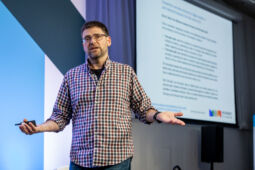
In this episode of A Coffee With... Nat Poulter, co-founder & CEO of Restless, joins ExchangeWire's John Still over a flat white to chat AI, creative, and how the path from discovery, consideration, to purchase is changing.
Founded in February this year, Restless had a blank sheet of paper to define what a new agency should look like in a world of AI – rather than retrofitting or crowbarring AI into existing workflows, which many of the bigger independents and network agencies have to do. To become an AI-native agency, they looked at how to leverage technology for both existing infrastructure and custom software.
Too often, creative directors have pinned ideas to an insight and run off in the wrong direction, resulting in content that doesn't land with specific personas or segments. The direction of travel is to aggregate information to understand different personas, allowing agencies to reframe concepts to speak directly to target audiences. Creative will become the new targeting, informed by AI-driven insights.
What is an AI-native agency?
Nat breaks down an AI-native agency into two worlds, the first being infrastructure. Agencies should look at their underlying workflows to figure out how they can build agentic systems to automate the heavy lifting and improve efficiency. The second is custom software – how they use AI to build tools which make their services significantly more effective.
Every small growing agency needs a new, whirring business arm. Restless has essentially codified the brains of the experts that live within their organisation, such as their VP of performance, to accomplish tasks. By automating repeated parts of their workflow, it frees up time for the team to focus on what really drives value for clients.
AI insights & creative strategy
Nat emphasises the need to understand where both AI and humans add value. AI is good at pattern recognition, synthesising the signal amongst vast amounts of data. This can then be put into the hands of experts. Rather than replace humans, AI functions as the force multiplier across their strengths. The human touch not only remains essential, but becomes even more important.
"I think creativity is about deviating away from the mean; it's about breaking that. And so I do think that they need to work together. AI comes together, it surfaces all the information, it puts it in the hand of the creative strategist, and then they use that to find a meaningful truth or something that resonates with someone, and they use that to leapfrog off of... as a springboard to jump off with new ideas." — Nat Poulter
Antenna, Restless' custom creative intelligence platform, pulls in data packs from clients, customer interviews, brand surveys, and social media. With the vast amount of context that sits within the software, it can surface key insights that shape creative strategy. This takes away the long hours of research, arming teams with information to come up with better, more personalised ideas.
Personas & personalised media
We live in a world where media activation has become automated. A big chunk of attention is captured by the walled gardens, which all have automated bidding strategies whereby they will find your audience for you. Now, agencies can also chat with synthetic personas to test concepts, ideas, and hooks before spending on any media.
Nat thinks creative will essentially become the new targeting, and that is informed by insights. As agencies build feedback loops, we could start to move towards real, personalised creative. That creative can be run through different media channels to reverse engineer why it may or may not have worked, and continuously iterate as time goes by.
AgencyAgentic AIAIAutomationCreativeDataMediaPerformancePersonalisation



Popular Tradertalks


Latest Posts
-
 The Stack: The Ad Duopoly?
 -
 Digest: Programmatic DOOH Reaches $1.34bn Globally; Shein Stock Hits New Low Since IPO
 -
 The Ad Tech Toll Road
 -
 Digest: AI Strengthens Big Tech’s Hold on Ad Growth; China Pulls Ahead of US in Consumer AI Adoption
 -
 Ad Tech Personality of the Year and Ad Tech Rising Star 2026: Shortlists Revealed
Follow ExchangeWire